
Last Updated: October 31, 2026
Quick Summary
Improving towing safety protocols means writing one standard that every driver follows the same way. Start with a pre-trip inspection checklist, verify weights and tongue load with a scale before every haul, and set a repeatable maintenance schedule. Pair these with driver training on sway, braking and emergencies, plus incident reporting.
- Give drivers a short pre-trip checklist covering tires, trailer lights, hitch, safety chains and brakes.
- Weigh the rig with a public scale and compare each reading to its matching rating, not just total weight.
- Use a tongue scale or the three-pass method to measure tongue weight before every haul.
- Train drivers through initial instruction, supervised practice, operator evaluation and written employer authorization.
- Require reporting of near misses and minor incidents to spot patterns before a serious accident occurs.
Table of Contents
- Why Towing Safety Protocols Need a Written Standard
- Step 1: Build a Pre-Trip Inspection Checklist for Tow Vehicle and Trailer
- Step 2: Verify Weight, Tongue Load and Weight Distribution Before Every Haul
- Step 3: Set a Repeatable Inspection and Maintenance Schedule
- Step 4: Train Drivers on Sway Control, Braking and Weather Risk
- Step 5: Set Up a Towing Driver Incident Reporting Training Program
- Step 6: Align Your Protocols With an OSHA Towing Safety Compliance Checklist
- Step 7: Build Towing Fleet Risk Management Strategies That Hold Up
- Frequently Asked Questions
Why Towing Safety Protocols Need a Written Standard
Most towing companies have safety habits. Far fewer have written safety protocols that every driver follows the same way.
A written standard gives your team one set of steps, one checklist, and one record of what was done, and something to point to after an incident.
Scomac Associates LLC focuses on closing the gap between what a safety manual says and what happens on the road. For how incident handling can be structured to hold up after a problem, see towing incident defensibility strategies.
Step 1: Build a Pre-Trip Inspection Checklist for Tow Vehicle and Trailer
A pre-trip inspection is the first line of defense. Before any haul, the driver should check the tow vehicle, the trailer, the hitch, and the connections between them.
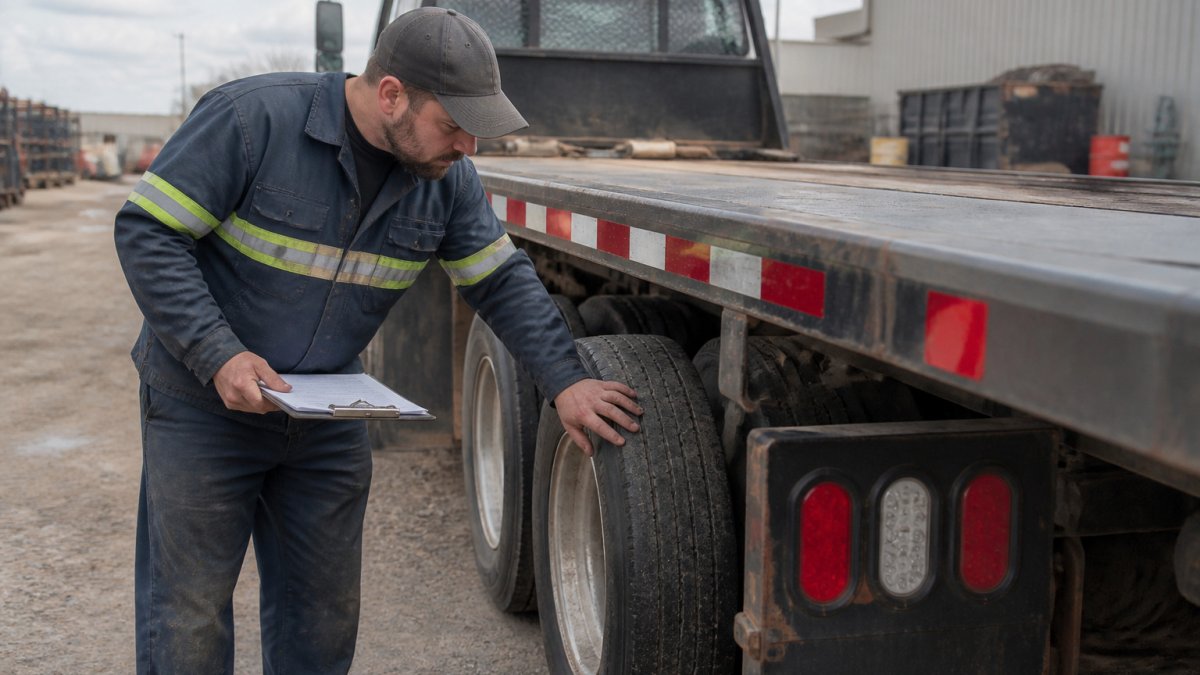
Your checklist should cover:
- Tires: Check pressure, tread wear, and sidewall condition on the tow vehicle and every trailer axle.
- Trailer lights: Test brake lights, turn signals, and running lights, including the electrical connection.
- Hitch and coupling: Confirm the hitch ball, coupler, and locking mechanism are secure and correctly rated.
Keep the checklist short enough that drivers actually use it. A one-page form with check boxes works better than a long manual nobody opens.
Watch out: A checklist filled in without the walk-around is worse than no checklist, because it creates a false paper trail.
Step 2: Verify Weight, Tongue Load and Weight Distribution Before Every Haul
Weight is where many towing incidents start. An overloaded or poorly balanced trailer changes how the rig handles, brakes, and turns. The sticker tells you the limit, not what your rig actually weighs on the day of the haul.
Know the five ratings before you load
Every tow vehicle and trailer carries ratings that must all be satisfied at the same time. A rig under its gross combined rating can still be over on an axle or on tongue weight.
- Gross vehicle weight rating (GVWR): The maximum the tow vehicle can weigh, including passengers, fuel, tools, and tongue load.
- Gross trailer weight rating (GTWR) or trailer GVWR: The maximum the trailer can weigh, including cargo.
- Gross combined weight rating (GCWR): The maximum combined weight of the tow vehicle and loaded trailer together.
Find these on the tow vehicle’s certification label (usually the driver’s door jamb), the trailer’s data plate, and the hitch manufacturer’s label. Record them on the haul paperwork before loading.
Measure real weights with a scale, not a guess
A public scale, a certified truck scale at a truck stop, a co-op, or a recycling yard, gives you the actual numbers. A typical three-pass weighing works like this:
- Weigh the tow vehicle alone, with the driver, fuel, and normal gear aboard. Note front and rear axle weights if the scale provides them.
- Weigh the loaded rig with the trailer coupled and the tongue supported by the hitch. This gives combined weight and, on a split scale, steer, drive, and trailer axle weights.
- Weigh the trailer alone with the tongue on a separate pad or a tongue scale. The difference between loaded rig weight and tow vehicle weight gives loaded trailer weight; the load the trailer places on the hitch is tongue weight.
Compare each reading to the matching rating. If any single number exceeds its rating, even when the total is under GCWR, the rig is overloaded for that component and needs to be re-loaded or re-configured.
A common pattern in towing incident reviews is a rig that is legal on total weight but over on rear axle weight or tongue weight. The scale catches that; the sticker does not.
Set tongue weight as a percentage, not a feeling
Tongue weight should fall within the range the tow vehicle and hitch manufacturers specify. Always defer to the tow vehicle and hitch manufacturers’ published tongue weight range. Too little invites sway; too much can overload the rear axle and unload the front steering axle.
Measure tongue weight with a tongue scale or by using the three-pass method above.
Distribute the load, then re-weigh
Load heavier items over or just ahead of the trailer axles. Keep weight off the extreme rear, which lightens the tongue and promotes sway.
If your operation uses a weight distribution hitch, set it for the current load, then re-weigh to confirm the front axle is restored toward its unloaded weight without overloading the rear axle. These hitches move load between axles; they do not raise your ratings.
Keep the numbers with the haul
Record the scale readings, the ratings they were compared against, and the driver’s sign-off on the haul paperwork. That forces the check to actually happen and gives you documentation if a load is later questioned. A written weight-verification step is one of the highest-value additions you can make to a towing safety protocol, and the step most operations skip.
The five ratings a rig must satisfy at the same time are summarised below, so you can check each one before loading.
| Rating | What it limits | Where to find it |
|---|---|---|
| GVWR | Tow vehicle weight, including passengers, fuel, tools and tongue load | Tow vehicle certification label |
| GTWR or trailer GVWR | Trailer weight, including cargo | Trailer data plate |
| GCWR | Combined tow vehicle and loaded trailer weight | Tow vehicle and trailer labels |
| GAWR | Load on each front and rear axle | Vehicle and trailer labels |
| Tongue weight rating | Downward load on hitch, ball mount and receiver | Hitch manufacturer label |
Step 3: Set a Repeatable Inspection and Maintenance Schedule
Pre-trip checks catch day-to-day problems. A maintenance schedule catches the problems that build up over weeks and months, such as worn brake pads, aging tires, and corroded wiring.
Build a schedule that covers:
- Daily or per haul: The pre-trip inspection from Step 1.
- Weekly: Tire pressure and tread checks, lighting function, hitch wear.
- Monthly: Brake inspection, safety chain and breakaway system check, electrical connector cleaning.
Assign one person to own the schedule. When everyone is responsible, nobody is. Keep the maintenance log with the equipment so anyone can see when something was last checked.
Step 4: Train Drivers on Sway Control, Braking and Weather Risk
Equipment and weight matter only if the driver knows how to handle the rig when something goes wrong. Training should cover the situations that cause most towing problems, and be structured so you can show each driver was trained, evaluated, and authorized, not just handed a manual.
Build a competency progression, not a one-time talk
A workable driver training program has four stages:
- Initial training: Classroom or online instruction covering weight and loading, inspection, hitch and brake setup, sway causes, braking distances, and emergency procedures.
- Behind-the-wheel practice: Supervised driving in an empty lot or closed course, then on low-traffic roads, then on the routes the driver will actually run.
- Operator evaluation: A documented assessment by a qualified evaluator who observes the driver perform specific maneuvers and emergency responses.
- Employer authorization: A written record that the employer has authorized the driver to operate specific equipment. Training alone does not authorize operation; the employer does.
Refresher training and periodic re-evaluation should follow at intervals you set in the protocol, and after any incident, near miss, or change in equipment.
Practice specific maneuvers, not just ‘driving’
Hands-on sessions beat reading alone. A driver who has practiced a sway recovery in a safe lot is far better prepared than one who has only seen a slide. To weigh in-person sessions against online options, compare hands-on and online safety training. For practical guidance on reducing near-miss incidents on the road, see near-miss reduction for drivers.
- Straight-line backing and offset backing into a marked bay, with a spotter.
- 90-degree turns that require tracking the trailer’s off-tracking and clearing curbs and poles.
- Lane changes and merges with tow mirrors, checking blind spots.
Teach the emergency procedures explicitly
Most drivers have never practiced a trailer emergency. Write the procedures down, train them, and drill them.
Trailer sway: Ease off the throttle gradually, hold the steering steady, and avoid hard braking or jerking the wheel.
Tire failure: Grip the wheel firmly, keep the rig straight, ease off the throttle, and let the vehicle slow gradually.
Brake problems: If trailer brakes fail or drag, reduce speed using the tow vehicle’s brakes and engine braking, and pull off as soon as it is safe. Addressing these mechanical failures immediately prevents secondary complications and ensures that you maintain the necessary control for damage-free vehicle recovery.
Disconnected trailer: If the trailer separates, the breakaway system should apply the trailer brakes.
What not to do matters as much as what to do. Sudden braking, sharp steering, and getting out of the vehicle in traffic are the most common mistakes in trailer emergencies.
Set weather and route rules drivers can act on
Crosswinds, rain, ice, and steep grades change how the rig behaves. Rather than leaving the call to driver judgment alone, set written thresholds, for example, a gust level at which a high-profile trailer haul is delayed, or a rule that steep-grade routes require a lower gear and a pre-trip brake check. Drivers should know they have your backing to delay a haul or choose a different route.
Document competency
Record which drivers completed which training, who evaluated them, and when the employer authorized them. That record turns ‘we train our drivers’ into evidence you can produce after an incident. If you want a structured program built around your equipment and routes, you can contact Scomac Associates LLC about professional instruction.
Step 5: Set Up a Towing Driver Incident Reporting Training Program
Every incident is a source of information. If drivers do not report near misses and minor problems, you lose the chance to fix the cause before a serious accident happens.
A towing driver incident reporting training program should teach drivers:
- What counts as a reportable event, including near misses, not only collisions.
- How to report quickly, while details are fresh.
- What to record: time, location, weather, load weight, equipment involved, and what happened.
Pair the training with a simple reporting form and a review process.
Good documentation also protects your company. If an incident leads to a claim, a clear record showing training, inspections, and corrective action is far stronger than memory and scattered notes.
Step 6: Align Your Protocols With an OSHA Towing Safety Compliance Checklist
Your towing safety protocols should reflect the rules that apply to your operation.
The Occupational Safety and Health Administration (OSHA) publishes general industry and construction standards that can apply to workers in towing and recovery settings, particularly around hazards such as working near traffic, lifting, and equipment use. Review the OSHA standards and regulations to identify the requirements that fit your work.
Separately, if your drivers operate commercial motor vehicles, Federal Motor Carrier Safety Administration (FMCSA) regulations may apply. See FMCSA regulations for commercial motor vehicles to determine whether they cover your fleet.
Use this checklist to compare your current protocols against the rules:
- Identified every federal and state requirement that applies to your operation
- Documented how each requirement is met in your written protocols
- Assigned an owner for each compliance task
Distinguish mandatory legal requirements from best practices. An industry guideline is useful, but it is not the same as a legal obligation. Label them separately in your protocols.
If you are unsure how the rules apply to your operation, a professional safety review can help you sort it out. To see which outside consultants can review a program against these requirements, explore safety consultants for towing.
Step 7: Build Towing Fleet Risk Management Strategies That Hold Up
Once your protocols exist, they need to survive real use. A strong fleet risk management approach ties the steps above into one system.
Focus on these points:
- Clear ownership: Name who approves protocols, who trains drivers, and who reviews incident reports.
- Consistent enforcement: Protocols only work when they apply to everyone, including experienced drivers.
- Regular review: Look at incident data, inspection records, and training results at least once a year, and update the protocols when you find gaps.
Defensibility depends on this documentation. If an incident occurs, you want to show a written standard, trained drivers, completed inspections, and a documented response.
Scomac Associates LLC offers hands-on training and towing-specific policy development. If you want an outside look at your current protocols, you can request a consultation through the Scomac Associates LLC website.
Frequently Asked Questions
What are the OSHA requirements for towing operations?
OSHA does not have a single towing standard. Towing operators typically fall under general duty obligations and standards that apply to the work being performed, such as hazard communication, personal protective equipment, and work at height where relevant. Fleet operators also face Department of Transportation rules through the Federal Motor Carrier Safety Administration for commercial vehicles, including driver qualification and vehicle inspection requirements. Because applicable rules depend on your operation, vehicles, and work type, review your specific activities with a qualified safety professional or counsel rather than relying on a general summary.
How often should towing safety training be conducted?
Training frequency depends on the requirements that apply to your operation and on your own risk assessment. Many employers provide initial training at hire, refresher training after an incident or near miss, and periodic refreshers when procedures change or equipment is added. Document each session with attendance records, topics covered, and the date. Scheduling refreshers at least annually is a common practice, but treat that as an internal policy choice rather than a universal legal requirement unless a specific rule applies to your work.
What should be included in a towing driver incident reporting policy?
A solid incident reporting policy should define what counts as an incident, including property damage, near misses, injuries, and sway or braking events. It should specify who reports, the timeline for reporting, the information required such as location, weather, load weight, and witness contact details, and how the report is reviewed. Include a clear process for preserving photos and vehicle data, and ensure drivers know reporting without fear of discipline is expected for near misses.
How can Scomac Associates help with towing safety compliance?
Scomac Associates LLC provides field-based safety training and consulting for towing, emergency response, and industrial operations. Services include towing-specific policy development and hands-on driver instruction. For current service options, scope, and a quote, contact Scomac Associates LLC directly through its website.
