
Last Updated: November 6, 2026
Quick Summary
A towing company risk assessment checklist turns general hazards into specific, scored, and documented items that match roadside work. It covers traffic exposure, vehicle and equipment condition, load handling, scene conditions, and human factors, then scores each risk for likelihood, severity, and residual risk.
- Scope the assessment to every task drivers perform, including hookups, winching, flatbed loading, and scene clearance.
- Score each hazard on a 1-to-5 likelihood and severity scale, then multiply the two for a risk score from 1 to 25.
- Give every risk row a named control owner, a due date, and a verification date so the score leads to action.
- Pull a tow truck from service until any defect found in the pre-trip inspection is corrected.
- Pair every training session with an observed operator evaluation and a signed employer authorization before unsupervised work.
Table of Contents
- Why a Towing Risk Assessment Needs to Cover the Roadside
- Step 1: Build the Hazard List for Your Operation
- Step 2: Score Each Risk for Likelihood, Severity, and Residual Risk
- Step 3: Run the Tow Truck Inspection Checklist
- Step 4: Verify Driver Competency and Safety Training
- Step 5: Set Up Incident Reporting and Near-Miss Review
- Scheduling Your Next Risk Review and Getting Help With the Program
- Frequently Asked Questions
Most towing companies have a written safety manual. Far fewer have a risk assessment that a field crew actually uses on a dark shoulder with traffic passing at 60 miles per hour. A towing company risk assessment checklist closes that gap by turning general hazards into specific, scored, and documented items that match the work you do on the roadside.
Why a Towing Risk Assessment Needs to Cover the Roadside
A towing risk assessment has to cover the roadside, because that is where most towing exposure begins and ends.
Your crews work in places you do not control. They face traffic, weather, unfamiliar vehicles, and customers who are upset or injured.
Scope the assessment to every task your drivers perform. That includes hookups, winching, flatbed loading, dolly work, and scene clearance.
Step 1: Build the Hazard List for Your Operation
Start by listing the tasks your drivers perform from dispatch to release. Walk through a real call from start to finish, and write down every point where someone could be hurt, a vehicle could be damaged, or a customer’s property could be harmed.
Group the hazards into categories so the list stays manageable:
- Traffic exposure: working beside live lanes, reduced visibility, and passing vehicles
- Vehicle and equipment: brakes, tires, winch and boom condition, and hydraulic systems
- Load and vehicle handling: securement, shifting loads, and unstable vehicles on slopes
Involve the drivers in this step. The people who work the calls will name hazards that a manager never sees from the office. Record each hazard with a short description and the task where it occurs.
Step 2: Score Each Risk for Likelihood, Severity, and Residual Risk
A hazard list without scores becomes a wish list. Scoring forces you to decide which hazards get money, training time, and equipment first. The method below is deliberately simple so a supervisor can complete it in the yard, not in a spreadsheet training class.
Use a 1-to-5 scale for likelihood and severity
Define each number in writing so two supervisors score the same hazard the same way. A common pattern is:
| Score | Likelihood (how often it could cause an incident) | Severity (how bad the outcome would be) |
|---|---|---|
| 1 | Rare, not expected in normal operations | First aid or minor property damage |
| 2 | Unlikely, could happen over years | Recordable injury or repairable vehicle damage |
| 3 | Possible, has happened in the industry | Lost-time injury or major equipment damage |
| 4 | Likely, has happened in your operation | Serious injury or vehicle totaled |
| 5 | Almost certain, happens routinely | Fatality or multiple serious injuries |
Multiply likelihood by severity to get an initial risk score from 1 to 25. Set your action bands in advance. A workable pattern many towing operators use:
- 20-25 (critical): stop the task or add an interim control before the next call; owner assigned; review within 7 days
- 12-19 (high): specific control required; owner assigned; due date within 30 days
- 6-11 (medium): control scheduled in the next review cycle
Add the fields that make the score usable
A score with no owner and no review date is a number nobody acts on. Every row in your risk register should carry these fields:
- Hazard and task, short description and where it occurs (for example, “winch cable failure during off-angle pull”)
- Initial likelihood and severity, scored before controls
- Initial risk score, likelihood × severity
- Existing controls, what is already in place today
- Residual likelihood and severity, rescored after controls
- Residual risk score, the number that tells you whether the control is enough
- Control owner, a named person, not a department
- Due date, the date the control must be in place
- Verification date and result, when someone confirmed the control works
- Review date, when the row gets rescored
Work a real example
Take “traffic exposure while hooking a vehicle on a shoulder.” Before controls, likelihood might be 4 (likely, given daily exposure) and severity 5 (fatality), for a score of 20, critical.
Rescoring a hazard to a lower number without actually changing the control is a common way a risk register becomes fiction. If the control did not change, the score should not change.
Tie the register to a review cycle
Review the full register at least annually and after any significant incident, new equipment, or change in service area. Review critical and high rows more often, quarterly is a common cadence. Keep the register with your inspection records and corrective-action log so an auditor, insurer, or investigator can see the full chain from hazard to control to verification.
Step 3: Run the Tow Truck Inspection Checklist
Pre-trip inspection is one of the most direct controls for mechanical hazards. Build a checklist that covers the systems your trucks depend on, and make it a required step before each shift.
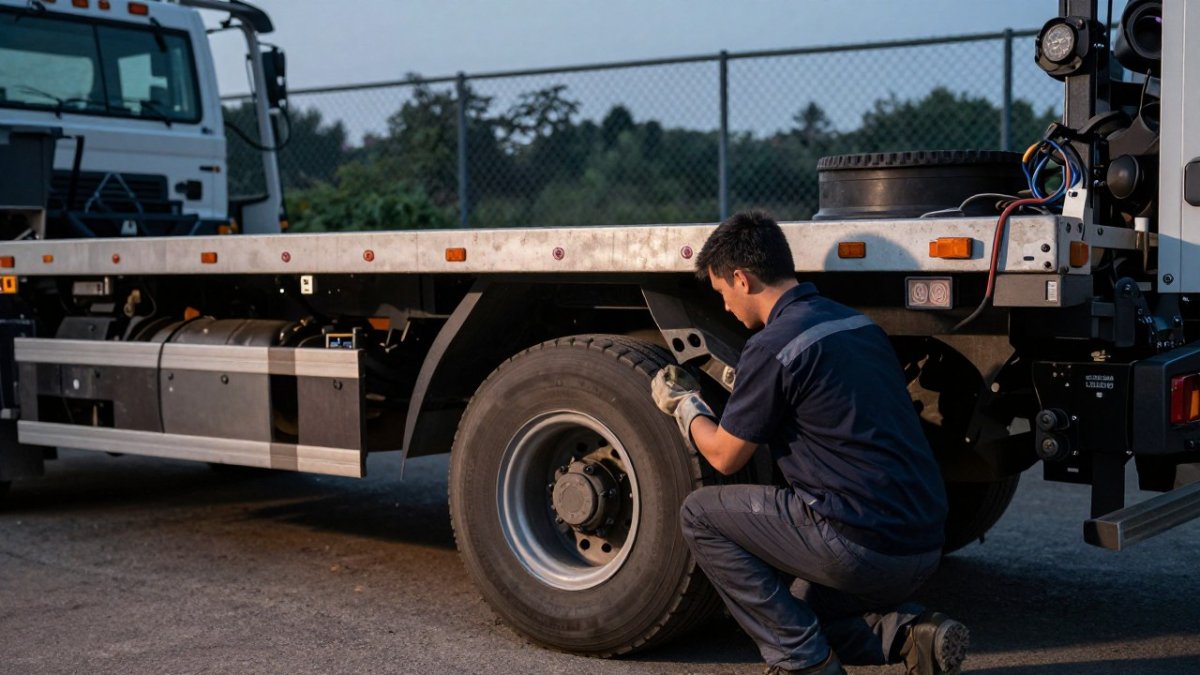
Work through these areas on every inspection:
- Tires: tread depth, inflation, sidewall damage, and lug condition
- Brakes: air or hydraulic pressure, pad condition, and warning lights
- Lights and reflectors: headlights, turn signals, brake lights, and amber warning lights
Record each inspection with the date, the driver, the vehicle number, and any defect found. Pull a unit from service until a defect is corrected. Keep these records with your risk assessment file.
Step 4: Verify Driver Competency and Safety Training
Your hazard list is only as useful as the drivers who apply it. Training records and competency records are not the same thing, and the gap between them is where most towing injuries originate. Build both. Drivers who can demonstrate sound judgment under pressure are better equipped to apply those competencies across roadside work, including preventing liability issues during emergency lockouts.
Separate the four things that get confused
Towing operators routinely treat these as one item. They are four distinct steps, and each needs its own record:
- Initial training, instruction on the task and the equipment, delivered before the driver performs the work unsupervised
- Operator evaluation, a practical check that the driver can actually perform the task safely, observed by a qualified evaluator
- Employer authorization, a written decision by the employer that this driver may perform this task on this equipment
- Refresher training, periodic retraining and re-evaluation on a set schedule and after any incident or near miss
A signed attendance sheet proves step one happened. It does not prove steps two or three. Pair every training session with an observed evaluation and a signed authorization before the driver works the task alone. To see how small towing fleets structure their safety training, read how small towing fleets build safety training.
Build a task-by-task competency matrix
List every task your drivers perform and score each driver against it. A typical towing matrix includes:
- Light-duty hookup and tow
- Flatbed loading and securement
- Wheel-lift and dolly operation
For each driver and each task, record: date of initial training, date of last evaluation, evaluator name, result, authorization date, and next refresher due date. A driver who is authorized on flatbed loading but not on heavy recovery should be visible on the matrix at a glance.
Ground the training in the regulations that apply
Which requirements apply depends on your fleet, your operating area, and the work you do, so confirm the specifics with the applicable regulation rather than assuming. Two anchors are worth knowing:
- FMCSA hours-of-service and driver qualification rules apply to commercial motor vehicles that meet the regulatory thresholds. The driver qualification file requirements and hours-of-service limits are set out in 49 CFR Part 391 and Part 395. Confirm which of your units and drivers fall under them.
- OSHA requires employers to train employees on workplace hazards and to protect them from recognized hazards under the General Duty Clause (Section 5(a)(1)) and applicable standards. OSHA does not issue or endorse towing certifications, and a training certificate from any provider does not by itself establish competency.
Industry consensus standards such as ANSI and NFPA publications can inform your evaluation criteria, but they are voluntary unless adopted by reference in a regulation or contract. Treat them as best practice, not as legal mandates.
Make the evaluation observable
An evaluation that consists of a supervisor saying “looks good” is not an evaluation. Define the observable behaviors for each task and check them off during a live or simulated job. For flatbed loading, that might include: chocks set before loading, winch line inspected, deck clear, vehicle centered, securement points at the manufacturer’s specified locations, tension checked after the first mile, and a post-load walkaround.
Authorizing a driver on a task because the schedule is short-staffed can lead to a preventable injury. If the evaluation is not complete, the authorization is not complete.
Schedule refreshers and re-evaluations
Set a fixed refresher interval, annually is a common baseline, and trigger an out-of-cycle re-evaluation after any incident, near miss, equipment change, or extended absence from the task.
If you want an independent check on your competency matrix, evaluation criteria, or training records, Scomac Associates LLC provides practical, field-tested safety training and risk management solutions for towing, emergency response, and industrial operations.
Step 5: Set Up Incident Reporting and Near-Miss Review
Incidents show what the assessment missed. Near misses show it sooner, and they cost far less.
A workable process includes:
- A short form or app entry that a driver can complete at the scene
- A same-week review by a designated person who checks the facts
- A corrective action for each report, with an owner and a deadline
- A check that the corrective action worked before the item closes
Track corrective actions in a log. For a step-by-step approach to reducing near-miss incidents for drivers, see our how-to guide on near-miss reduction.
Document everything. Our guide to defensible approaches for towing company incident records explains how to keep these records useful if a claim follows.
Scheduling Your Next Risk Review and Getting Help With the Program
Set a fixed schedule for reviewing your towing company risk assessment checklist, at least once a year and after any significant incident, new equipment, or change in service area.
Many towing companies can build a usable program internally. If you want to compare outside options, review our towing safety consultant services before deciding. Others benefit from outside review, especially when they want an independent check on scoring, documentation, or training records.
Frequently Asked Questions
What should a towing company risk assessment include?
A useful towing risk assessment lists each task your crews perform, from hookups and winching to flatbed loading and roadside scene work. For each task, it names the hazards, such as traffic exposure, cargo shift, hydraulic failure and driver fatigue, then scores likelihood and severity. It also records the controls already in place, the residual risk after those controls, and who owns the follow-up. Keep the assessment tied to real jobs and update it after incidents, equipment changes, or new hires.
How often should a towing company review its risk assessment?
Review the assessment at least once a year and whenever something material changes, such as a new truck or boom, a new service line, a move to a different roadway type, or a serious near miss. Many operators also review it after a seasonal peak. The review should check whether the hazards you listed still match how crews actually work, not just whether the paperwork is filed.
Can a checklist replace towing safety training?
No. A checklist tells a driver what to check and records that the check happened, but it does not build the judgment needed to set up a scene, manage traffic exposure, or recognize an unsafe load. Training and documented driver competency should work alongside the checklist. Whether any specific training is required depends on your operation and the rules that apply to it, so confirm those requirements with your compliance advisor.
What should a towing company incident report include?
A complete incident report records the date, time, location, and weather, the vehicles and equipment involved, the people present, and a factual description of what happened in sequence. It should note any injuries, property or vehicle damage, witness names, and photos taken at the scene. Add the immediate actions taken, the suspected contributing factors, and the corrective action assigned with an owner and a due date. Avoid speculative blame in the narrative.
