
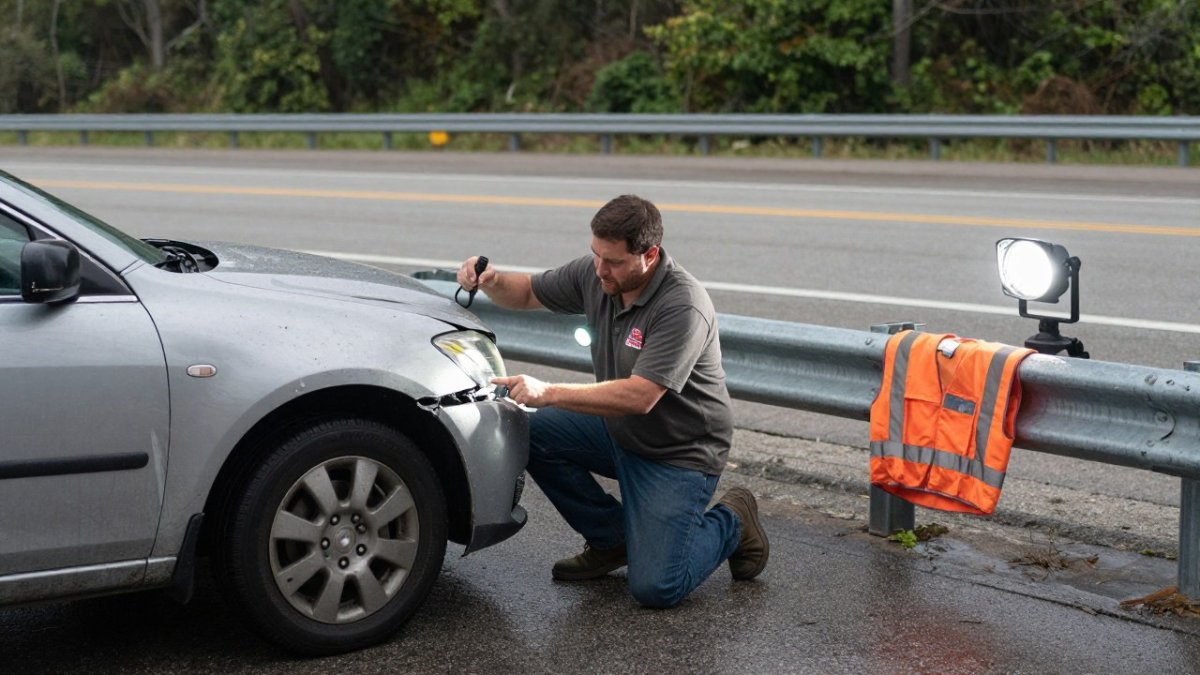
Quick Summary
Incident reporting training teaches field crews what events to report, how fast to report them, and what details to record. It covers injuries, near misses, hazards, and property damage, plus the escalation path and a paper fallback for areas with limited connectivity.
- Crews should report injuries, near misses, hazards, and property damage, not only injuries.
- Near misses are the most underreported category and often signal the injury that could follow.
- Follow a four-phase sequence: stabilize, capture, notify, then document and submit.
- Keep paper forms and an escalation card in every truck so reporting works without signal.
- Measure reporting timeliness, completeness, and near-miss volume rather than course completion.
Table of Contents
- What Incident Reporting Is and Why Field Crews Need Training
- Which Events Field Crews Should Report: Injuries, Near Misses, Hazards and Property Damage
- Step-by-Step Reporting Workflow for Crews With Limited Connectivity
- Role-Based Responsibilities and Escalation Paths
- Writing Clear, Factual Reports: Required Details and a Form Template
- Incident Investigation and Reporting: Evidence, Follow-Up and Corrective Action
- Building an Online Field Crew Training Program That Sticks
- Booking Customized Incident Reporting Training With Scomac
- Frequently Asked Questions
7 Steps to Effective Incident Reporting Training for Field Crews
Last Updated: November 8, 2026
What Incident Reporting Is and Why Field Crews Need Training
Incident reporting is the process of recording, communicating, and documenting any event that harms people, equipment, property, or the environment, or that could have.
Field work differs from shop work. Crews move between locations, work nights and weekends, and often have little or no cell coverage.
Reporting training helps close the gap between written policy and what happens on the road by teaching crews what to report, when, and how.
What good reporting training should cover:
- What counts as a reportable event
- How quickly the report must be filed
- What details to include
Which Events Field Crews Should Report: Injuries, Near Misses, Hazards and Property Damage
Crews should report four main types of events: injuries, near misses, hazards, and property damage. Many crews only think to report the first one.
- Injuries: Any harm to a worker, including minor cuts or strains that need first aid.
- Near misses: Events that could have caused harm but did not, such as a vehicle nearly striking a cone.
- Hazards: Unsafe conditions, like a loose load strap or a damaged traffic cone that has not yet caused a problem.
Near misses are the most underreported category, and a near-miss report is valuable because it can prevent the injury that would otherwise follow. For more on lowering near-miss rates among drivers, see our guide on Reducing Near Miss Incidents for Drivers: A How-To Guide.
The four event types crews should report are summarised below, with a short description of each.
| Event type | What it covers | Reporting note |
|---|---|---|
| Injuries | Harm to a worker, including minor cuts or strains needing first aid | Report even when minor |
| Near misses | Events that could have caused harm but did not | Most underreported category |
| Hazards | Unsafe conditions not yet causing a problem | Example: loose load strap |
| Property damage | Harm to vehicles, equipment or others’ property | Includes damage to others’ property |
Step-by-Step Reporting Workflow for Crews With Limited Connectivity
Crews without reliable signal still need a workable process. The mistake most employers make is treating the mobile app as the process.
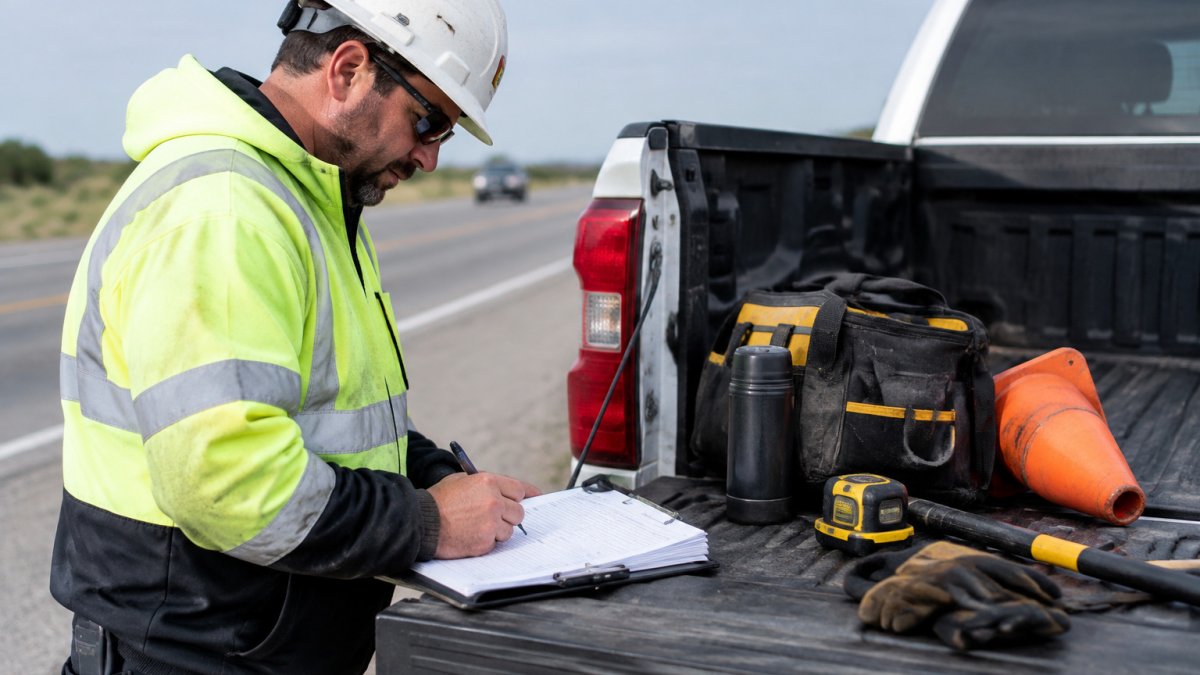
Phase 1, Stabilize (first minutes, no paperwork yet)
- Secure the scene. Stop work, protect people, and warn traffic and other workers. Nothing gets written until the scene is safe or the crew has moved to a safe position.
- Get medical help if needed. Call emergency services before anything else. Emergency notification always outranks internal reporting.
- Preserve the physical evidence. Leave equipment, vehicles, and debris where they are unless they create a hazard. Do not clean up, reposition, or repair until photos are taken or a supervisor authorizes it.
Phase 2, Capture (before memory fades)
- Write notes on paper. Record time, location, people involved, witnesses, and what happened in sequence. Write in the past tense and stick to observations. Note the time you started writing, it becomes your documentation timestamp.
- Take photos and short video. Capture wide shots of the scene, close-ups of damage or the hazard, and any signage, cones, or barricades in place. Save to the device; do not rely on uploading in the field.
- Collect witness names and contact numbers. Ask each witness to write a short account separately if willing and able. Separate accounts are more useful than a group summary.
Phase 3, Notify (as soon as a channel exists)
- Report by radio or phone to the supervisor. Use a short verbal format: who, what, where, injuries, and whether the scene is stable. Verbal notification is not the report, it starts the clock on the supervisor’s response.
- Escalate serious events immediately. Any fatality, amputation, in-patient hospitalization, loss of an eye, or significant property or environmental damage should trigger the escalation path in the next section, not wait for the written report.
Phase 4, Document and submit
- Complete the full written report within the time your policy sets. Many employers set an end-of-shift deadline for the written report and a same-day deadline for supervisor review; confirm your own policy and train to it.
- Upload or submit the report and photos once connectivity returns. If the app failed, submit the paper form and note the failure so the reporting system itself gets fixed.
Designing the paper kit
Paper forms should live in the truck, the crew kit, and the supervisor’s vehicle, not only in the office. Keeping the quick-reference card beside the forms helps crews act on early warning signs and notify the right people promptly, a priority also emphasized by Stealth-ISS Group Inc.
Watch out: Crews that “report later” from memory routinely lose the exact time, the witness list, and the position of vehicles. Build the paper capture step into the job briefing so it happens before the crew leaves the scene.
When connectivity is intermittent, not absent
Many field locations have enough signal for a text but not a full upload.
Role-Based Responsibilities and Escalation Paths
Each role on a crew needs to know its part in reporting. Confusion about who calls whom is one of the most common causes of late reports.
- Crew member: Reports the event to the crew lead immediately and writes down what they saw.
- Crew lead or supervisor: Confirms the facts, makes the initial report to management, and secures the scene.
- Safety coordinator or manager: Reviews the report, assigns follow-up, and decides whether outside notification is required.
Write the escalation path on a card kept in each vehicle. The card should list names, phone numbers, and the time limit for each step.
Writing Clear, Factual Reports: Required Details and a Form Template
A useful report answers who, what, when, where, and how, without guessing. Stick to facts and avoid opinions about blame.
Required details:
- Date, time, and exact location
- Names and contact details of everyone involved and any witnesses
- A description of what happened, in order
Simple report template:
Incident Report
Date/Time: ____________
Location: ____________
Event type: [ ] Injury [ ] Near miss [ ] Hazard [ ] Property damage
People involved and witnesses: ____________
What happened (in order): ____________
Conditions (weather, lighting, site): ____________
Equipment or vehicles: ____________
Injuries and first aid: ____________
Reported by / to whom / time: ____________
Write what you saw, not what you think it means. “The cable snapped at the second anchor” is useful. “The crew was careless” is not.
Incident Investigation and Reporting: Evidence, Follow-Up and Corrective Action
A report starts the process. Investigation and follow-up are what prevent the next event.
Gather evidence quickly. Photos, witness statements, and equipment checks are most useful before conditions change.
Set corrective action. Each fix should have an owner and a due date.
Follow up. Check that the fix happened and that it worked.
Keep investigation records so you can spot patterns across incidents over time.
Building an Online Field Crew Training Program That Sticks
Most incident reporting training fails for a predictable reason: it teaches the form, not the decision.
A ready-to-use lesson plan
A practical starting curriculum runs about 60 to 90 minutes and can be split across two short sessions. Adjust the scenarios to your equipment, routes, and reporting form.
Learning objectives, by the end, each crew member can:
- Classify an event as an injury, near miss, hazard, or property damage, and explain why near misses are reported
- Run the stabilize-capture-notify-document sequence without prompting
- Complete the written report with all required fields and no speculation about cause or blame
Session 1, What and when (about 30 minutes)
- Opening scenario (5 min). Read a short event aloud, a cone struck by a passing vehicle, no injuries, and ask the crew whether it gets reported. Capture answers before teaching anything.
- The four categories (10 min). Walk through injuries, near misses, hazards, and property damage with one local example each. Emphasize that near misses are the leading indicator and the most underreported category.
- Timing and escalation (10 min). Cover the verbal notification, the written report deadline, and the serious-event triggers. Hand out the escalation card and have each person read their own role aloud.
- Knowledge check (5 min). Five rapid-fire scenarios; crew members call out reportable or not reportable and why.
Session 2, How to document (about 45 minutes)
- Anatomy of a good report (10 min). Show one vague report and one factual report side by side. Ask the crew to identify which fields are missing and which sentences state opinion rather than observation.
- Guided practice (20 min). Give each crew member a scenario card and a blank form. They complete the form as if they had just arrived at the scene. Circulate and coach on missing fields, timeline gaps, and editorial language.
- Peer review (10 min). Swap forms. Each reviewer marks any sentence that states a conclusion instead of an observation.
- Offline drill (5 min). Simulate no signal: crew writes notes on paper, gives a 30-second verbal report to a partner acting as supervisor, then submits the written form.
Scenario cards to build the exercises around:
- A near miss on a roadside: a passing vehicle clips a traffic cone and drives on
- A minor injury: a crew member strains a back lifting a toolbox and declines medical attention
- Property damage: a truck backs into a customer’s fence, no injuries
Measuring whether training worked
Do not measure completion. Measure reporting quality. Track a small set of indicators before and after training and review them monthly:
- Timeliness: share of reports submitted within the policy deadline
- Completeness: share of reports with all required fields filled, especially time, witnesses, and photos
- Near-miss volume: near-miss reports per crew per month, a rising count after training usually means reporting barriers came down, not that conditions got worse
Watch out: If near-miss reports stay at zero after training, check whether reports trigger blame, whether the form takes too long, and whether supervisors respond at all.
Format trade-offs
Short online modules reach crews across shifts and locations and work well for the knowledge portions, categories, timing, escalation, and form fields. For guidance on that choice, see our article on How to Choose Between Hands-On and Online Safety Training. For a broader overview of training for field staff, read The Complete Guide to Industrial Safety Training for Field Staff.
Consistency across shifts is one of the hardest parts of training. See Standardize Safety Across Multiple Shifts: A How-To and How Do You Keep Safety Consistency Across Shifts? for practical steps.
Booking Customized Incident Reporting Training With Scomac
Every field operation has its own equipment, routes, and risks. Generic training rarely matches what crews face day to day.
Scomac Associates LLC provides practical, field-tested safety training and policy development for towing, emergency response, and industrial operations.
To discuss training for your crews, contact Scomac Associates LLC through its website to learn more about available programs and to request a quote.
Frequently Asked Questions
Frequently Asked Questions
What should field crews report as an incident?
Field crews should report injuries, near misses, hazards, equipment failures and property damage, even when the event seems minor. Near misses matter most because they reveal conditions that could cause injury next time. Employers should define these categories in their written reporting policy so every crew member applies the same standard. Training should include real examples from your own operations so workers can recognize reportable events on the job rather than guessing.
How soon should a worker report an incident or near miss?
Workers should report injuries and hazards immediately, or as soon as it is safe to do so, and near misses before the end of the shift. Delayed reporting weakens the accuracy of witness recall and makes investigation harder. Your policy should set a specific deadline and name who receives the report. Supervisors should confirm in training that crews know how to reach them when they have no cell signal.
What information should a field incident report include?
A complete report answers who, what, when, where and how, and it lists witnesses, equipment involved and any immediate actions taken. Describe facts only, without assigning blame or guessing at causes. Photos, the job or site identifier and the time of the event make follow-up far more effective. Use a standard form so every crew member captures the same details, which also makes trend analysis across locations possible.
How can supervisors train crews to write clear incident reports?
Supervisors can run short practice exercises using realistic scenarios, such as a near miss during a tow or a hazard at a shoulder work zone. Crew members write a report, then compare it against a checklist of required details. Repeat the exercise quarterly and review anonymized examples in toolbox talks. Reinforcement works better than a single classroom session, especially for newer hires.
