
Table of Contents
- Why Incident Defensibility Matters for Towing Operations
- Building a Towing Company Incident Report Template
- Conducting a Tow Truck Accident Investigation Checklist
- Incident Evidence Preservation for Towing Companies
- Tow Truck Driver Incident Reporting Training
- Post-Incident Response and Claims Coordination
- Common Documentation Mistakes and How to Avoid Them
- Building a Defensible Safety Culture
- Frequently Asked Questions
Last Updated: October 21, 2026
Why Incident Defensibility Matters for Towing Operations
When something goes wrong at a tow scene, documentation determines the outcome. A well-documented incident with clear evidence and professional reporting protects your business, your drivers, and your reputation. Poor documentation leaves you exposed to liability claims, regulatory scrutiny, and operational chaos.
The real stakes are high. One incident can trigger lawsuits, regulatory investigations, and reputation damage that affects your ability to win contracts. But here’s what most towing companies miss: defensibility isn’t about having perfect luck. It’s about having perfect records.
Incident defensibility strategies start with systems, not luck. When your team knows how to document what happened, preserve evidence, and communicate findings clearly, you shift from reactive scrambling to professional response.
At Scomac Associates LLC, we work with towing operations to build incident response systems that hold up under scrutiny. The framework is straightforward: capture the right information at the scene, preserve it properly, train your team to report accurately, and coordinate with all parties involved.
Building a Towing Company Incident Report Template
Your incident report template is your foundation. Without it, drivers rely on memory, guesswork, or incomplete forms. A solid template ensures consistent capture of critical facts across every incident.
Core Information Every Report Must Capture
Start with the basics: date, time, location, personnel involved, and contact details. Then move to the incident specifics.
Your template should require:
- Scene conditions: Weather, lighting, traffic volume, road surface, hazards present
- Vehicles involved: Make, model, year, license plate, owner/operator information
- Personnel on scene: Names, titles, company affiliations of all responders and witnesses
- Sequence of events: What happened before, during, and after the incident (in chronological order)
- Actions taken: What your crew did, in what order, and why those decisions were made
- Equipment used: Towing gear, rigging methods, lifting techniques, recovery equipment deployed
- Injuries or damage: Any person injuries, property damage, or environmental concerns
- Witness statements: Names and contact information for anyone who observed the incident
- Photographs and video: References to images or footage captured (with timestamps and descriptions)
A good template forces completeness. It prevents the “I don’t remember” problem that weakens your defense later.
Include a field for the decision-maker’s reasoning. If your driver chose a specific rigging method or recovery approach, document WHY that choice was made. That reasoning becomes evidence of professional judgment, not negligence.
Timing and Witness Documentation
Timing matters. Record the exact time dispatch was received, when your crew arrived on scene, when work began, and when the scene was cleared. These timestamps create a defensible timeline.
Witness documentation is equally critical. Get names, phone numbers, and email addresses for anyone present. Brief notes about what they observed, without interpretation, become part of your record. A witness statement like “I saw the tow truck positioned at a 45-degree angle to the vehicle” is more valuable than “everything looked safe.”
Include space on your form for witness contact attempts. If a witness was unwilling to provide information or couldn’t be reached later, that’s documented too. It shows you made a professional effort.
Conducting a Tow Truck Accident Investigation Checklist
When an incident occurs, a structured investigation protects your operation and preserves evidence. The investigation happens in two phases: immediate scene response and detailed follow-up.
Immediate Scene Assessment and Safety Priorities
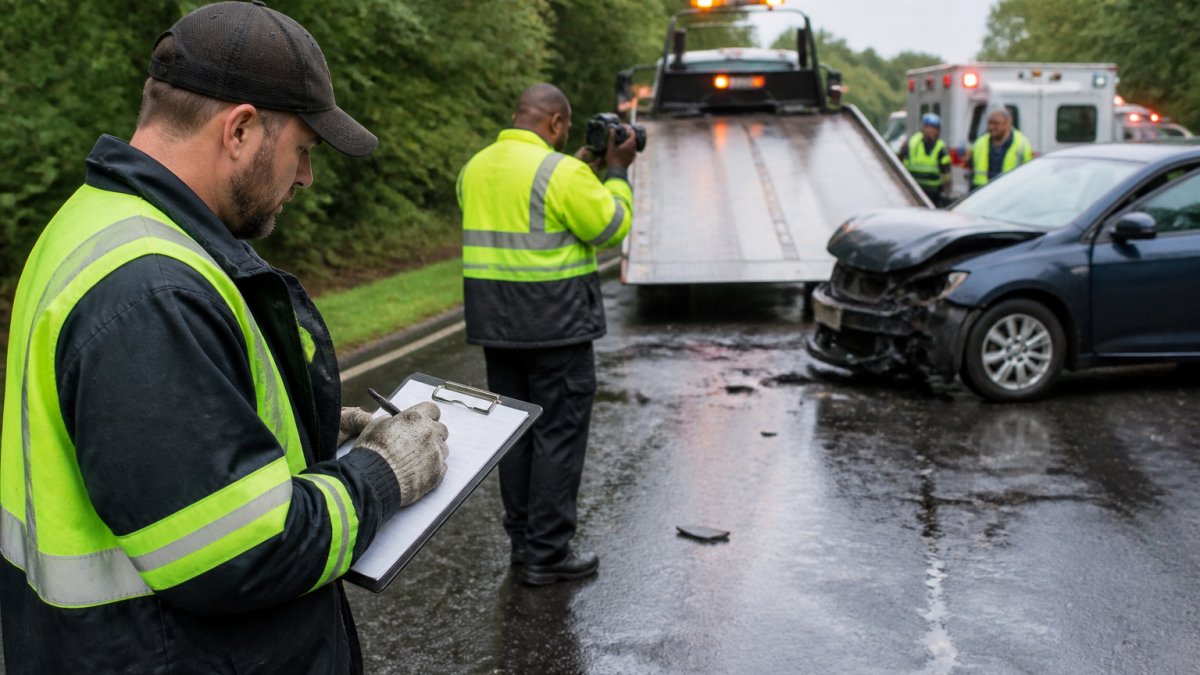
Your first job is safety, not evidence. Secure the scene, protect personnel, and ensure no additional incidents occur. Only after the scene is safe do you begin documentation.
During immediate assessment, capture:
- Scene layout: Photograph the overall area, vehicle positions, debris, and hazards
- Environmental conditions: Weather, visibility, road conditions, traffic flow
- Equipment positioning: Where your truck was parked, how it was oriented, what rigging was deployed
- Personnel placement: Where your crew members were standing, what they were doing
- Damage visible: Photos of all vehicle damage, equipment damage, or environmental impact
- Hazards present: Downed power lines, fuel leaks, unstable loads, traffic threats
Take photos from multiple angles. Include wide shots for context and close-ups for detail. Timestamp everything if your camera or phone records it automatically.
Do not move or disturb the scene before photos are taken. Once a vehicle is moved or rigging is removed, that evidence is gone forever. Photograph first, then proceed with recovery.
Evidence Collection and Sequence Documentation
After immediate safety is handled, document the sequence of actions your crew took. This is where decision-making becomes visible.
Record:
- What rigging methods were used and why that approach was chosen
- Load weight estimates if known, or how weight was determined
- Vehicle condition before work began (fluid leaks, structural damage, tire condition)
- Communication between crew members during the recovery
- Obstacles encountered and how they were addressed
- Any deviations from standard procedure and the reason for the deviation
- Final scene condition after work was complete
This sequence tells the story of professional judgment. It shows your team assessed the situation, made decisions based on that assessment, and executed those decisions competently.
Incident Evidence Preservation for Towing Companies
Evidence deteriorates, gets lost, or disappears. A preservation system keeps critical evidence intact and accessible.
Digital Records and Data Governance
Your incident reports, photos, videos, and communications must be stored securely and organized logically. A shared drive with no structure is not a system, it’s a filing cabinet where nothing can be found.
Establish a naming convention for all incident files. Example: INCIDENT_2026-10-15_LOCATION_DRIVERNAME_DESCRIPTION. This makes searching and retrieving evidence straightforward.
Store originals separately from working copies. If a claim arises later, the original timestamps and metadata prove the evidence wasn’t altered. Working copies can be reviewed without risking the original.
Back up all digital evidence. Cloud storage, external drives, or both. If your office floods or your server fails, your evidence shouldn’t disappear with it.
Retention Policies and Legal Hold Procedures
Establish a retention schedule.
When an incident triggers a claim or investigation, activate a legal hold. That means all related evidence, reports, photos, communications, maintenance records, is flagged as protected and cannot be deleted or destroyed. Make sure your team understands this requirement.
Document what you retain and why. If a lawyer later asks “Do you have photos from this incident?” and you can produce them immediately with timestamps intact, that credibility matters. If you say “We had them but deleted them after a year,” you’ve created a liability problem.
Tow Truck Driver Incident Reporting Training
Your drivers are your first responders. Their training determines the quality of your incident documentation.
Training Program Scope and Competency Standards
Your drivers need to understand:
- Why documentation matters (not just “because the boss says so,” but because it protects them personally)
- What information is critical to capture
- How to photograph scenes professionally
- How to write clear, factual descriptions without interpretation
- How to interact with witnesses and law enforcement
- When to stop work and call for assistance
- How to preserve evidence without contaminating it
Training should include real scenarios. Show drivers actual incident reports, both good ones and problematic ones. Let them see what happens when documentation is incomplete versus thorough.
Drivers who understand the “why” behind documentation procedures follow them consistently. Drivers who view procedures as busywork often skip steps.
Hands-On Scenarios and Real-World Application
Classroom training alone doesn’t work. Your drivers need to practice documentation in realistic conditions.
Run scenario exercises where drivers respond to a mock incident, document what they observe, and present their findings. Have them photograph a staged scene, write descriptions, and gather witness information. Then review their work together. What did they miss? What did they capture well? What could be clearer?
Real-world application means your drivers see incidents as opportunities to demonstrate competence, not problems to hide. That mindset shift changes behavior.
Post-Incident Response and Claims Coordination
After an incident occurs and documentation is complete, your response strategy matters.
Notify your insurance carrier promptly. Provide them with your incident report and evidence. Your insurer needs accurate information early to assess exposure and coordinate defense.
If law enforcement is involved, cooperate fully but carefully. Provide factual information without speculation. If your driver was involved, consider having them speak with an attorney before giving a detailed statement.
Coordinate with all parties. If other vehicles or property were involved, exchange information professionally. If injuries occurred, ensure medical attention was provided and documented.
Keep your team informed about what happened and how the incident is being handled. Uncertainty breeds rumors. Clear communication maintains professionalism and morale.
Document all post-incident communications. Emails to your insurance company, notes from conversations with law enforcement, correspondence with other parties, it all becomes part of your incident file.
Common Documentation Mistakes and How to Avoid Them
Most towing companies make predictable errors in incident documentation. Here’s how to avoid them.
Vague descriptions: “Everything looked normal” doesn’t describe anything. Instead: “Road surface was dry asphalt, lighting was adequate from streetlights, traffic volume was light.”
Missing context: Photos without captions are useless later. Always note what each photo shows, when it was taken, and from what angle.
Incomplete witness information: Get full names, phone numbers, email addresses, and what they actually saw. “A guy in a red truck” is not a witness.
Delayed reporting: Document incidents the same day they occur. Memory fades fast. What seems obvious today becomes fuzzy in three weeks.
No decision rationale: If your crew made a specific choice about rigging, positioning, or procedure, explain why that choice was made. Professional judgment is defensible.
Altered or corrected reports: If a mistake is made on an incident report, don’t erase or white-out it.
Building a Defensible Safety Culture
Incident defensibility isn’t a one-time project. It’s a culture where documentation, safety, and professional standards matter every day.
Start with leadership commitment. If your management team treats incident reporting as busywork, your drivers will too.
Make training ongoing. New drivers need foundational training. Experienced drivers need refresher training and exposure to new scenarios. Annual training keeps standards current.
Audit your own documentation. Regularly review incident reports from your operation. Are they thorough? Are they clear? Are they complete?
Recognize and reward good documentation. When a driver submits a comprehensive, well-organized incident report, acknowledge it. Make it clear that professional documentation is valued.
Connect incident defensibility to your broader safety program. How you respond to incidents reflects how seriously you take safety overall.
Towing operations face real risks. Equipment failures, traffic hazards, challenging recoveries, and unpredictable conditions create genuine incident exposure. You can’t eliminate that risk.
Incident defensibility strategies give you the systems, training, and documentation practices that demonstrate competent, professional operations.
Frequently Asked Questions
What information should a tow truck driver include in an incident report?
A complete incident report must capture the date, time, location, weather conditions, names and contact information of all parties involved, vehicle descriptions and license plates, a detailed narrative of what occurred, actions taken at the scene, names of witnesses, photographs or video evidence, equipment involved, and any injuries or property damage. Include the driver’s observations about road conditions, visibility, traffic patterns, and any unsafe behaviors that contributed to the incident. Avoid speculation or conclusions about fault; stick to observable facts and the sequence of events.
How should towing companies preserve evidence after a crash or injury?
Preserve all physical evidence at the scene through photographs and video from multiple angles, document vehicle positions and damage, collect contact information from independent witnesses, secure any communications (radio logs, dispatch records, text messages) from the date and time of the incident, and retain all equipment inspection records from the vehicle involved. Store digital records in a secure, time-stamped system with restricted access. Establish a legal hold procedure that prevents routine deletion of incident-related files. Maintain originals of handwritten reports and preserve the clothing or safety gear worn during the incident if injury occurred.
What training helps tow truck drivers report incidents accurately?
Effective incident reporting training must cover the legal and liability implications of incomplete or inaccurate reports, teach drivers to distinguish between observable facts and personal interpretation, provide hands-on practice completing actual incident report templates, include scenario-based exercises that mirror real-world towing emergencies, and establish clear communication protocols for reporting to dispatch and management. Training should emphasize that thorough, timely reporting protects both the driver and the company. Refresher training annually or after significant operational changes ensures skills remain sharp and procedures stay current.
How long should a towing company keep incident records?
Establish a documented retention schedule and ensure all staff understand which records must be preserved and for how long.