
Last Updated: November 1, 2026
Quick Summary
Risk management for emergency services means finding hazards before they cause harm, then putting controls in place to reduce how often harm happens and how severe it is. Start by listing every task crews perform, scoring each risk by likelihood and severity, and involving frontline responders. Then build a written, tested safety plan.
- Rate each hazard’s likelihood and severity from 1 to 5, then multiply to set priorities.
- Review your hazard identification checklist at least once a year and after any incident.
- Vehicle operations, lifts, battery fires, exposure hazards and fatigue are the main risk groups.
- Use a recognized framework such as NFPA 1600 or FEMA CPG 101 as the backbone of your plan.
- Test the safety plan through drills and measure results to find what needs revising.
Table of Contents
- Why Risk Management Matters for Emergency Services
- Identifying and Assessing Operational Risks
- Common Risks for EMS, Fire and Response Teams
- Building an Emergency Response Safety Plan Template
- Training Responders to Manage Risk in the Field
- Evaluating Risk Management Software and Tools
- Scheduling Your Next Risk Review with Scomac Associates
- Frequently Asked Questions
Why Risk Management Matters for Emergency Services
Risk management for emergency services is the practice of finding hazards before they hurt someone, then putting controls in place to reduce the chance and severity of harm.
Emergency responders face hazards most workplaces never see: vehicle collisions, lift and equipment incidents, smoke and hazardous materials exposure, and lithium-ion battery fires.
Good risk management also supports defensibility. When an incident is reviewed, you want records showing what hazards were identified, what controls were chosen, and how training was delivered.
Identifying and Assessing Operational Risks
Start by listing every task your crews do, from station duties to calls on scene. For each task, ask what could go wrong and who could get hurt.
A simple scoring method works well: rate likelihood from 1 to 5 and severity from 1 to 5, then multiply. Higher scores get attention first, keeping the process practical and focused on real exposure rather than theory.
Involve the people who do the work. Frontline responders often know about hazards that never make it onto a report, like a worn strap, a blocked exit or a driver who takes a corner too fast.
Using a Hazard Identification Checklist
A hazard identification checklist turns a vague idea into a repeatable habit. Walk through each station, apparatus and response activity, and mark what applies. Useful prompts include:
- Are walking surfaces and apparatus steps clear of slip and trip hazards?
- Is lifting equipment inspected on schedule and documented?
- Are chemicals and cleaning agents stored and labeled correctly?
Review the checklist at least once a year, and after any incident or major change in equipment or staffing.
Common Risks for EMS, Fire and Response Teams
Most risk exposure in these services falls into a few groups. Knowing them helps you focus your controls.
- Vehicle operations: Emergency driving, backing and tight-space maneuvers cause a large share of injuries and property damage.
- Lifts and equipment: Mobile elevating work platforms and hydraulic tools need trained operators and regular inspection. Learn how operator qualification for these lifts is structured on our MEWP operator certification page.
- Vehicle and battery fires: Lithium-ion batteries in electric vehicles and equipment can reignite and release toxic gas, which changes how crews must approach scene safety. Our lithium-ion EV fire training covers how to approach these incidents safely.
Watch out: treating a damaged lithium-ion battery as a routine fire can lead to delayed reignition after crews leave. Your procedures should specify how long to monitor and how to handle the vehicle afterward.
The main exposure groups for these services, and the control focus each one calls for:
| Risk group | What it involves | Key control focus |
|---|---|---|
| Vehicle operations | Emergency driving, backing and tight-space maneuvers | Injuries and property damage |
| Lifts and equipment | Mobile elevating work platforms and hydraulic tools | Trained operators and regular inspection |
| Vehicle and battery fires | Lithium-ion batteries that can reignite and release toxic gas | Scene safety and post-incident monitoring |
| Exposure hazards | Smoke, diesel exhaust and hazardous materials | Long-term health risks that build quietly |
| Fatigue and stress | Long shifts and constant alarms | Rest periods and staffing rules in the plan |
Building an Emergency Response Safety Plan Template
An emergency response safety plan gives your team one place to find key information during an incident. It should be short enough to use under pressure and detailed enough to guide decisions. What separates a plan that sits on a shelf from one that works on scene is the framework behind it, how it plugs into incident command, and whether you can prove it is improving.
Start With a Recognized Framework
Many emergency-service agencies build their plans on voluntary frameworks. Neither framework is a legal mandate on its own, but both are widely used.
- NFPA 1600, Standard on Continuity, Emergency, and Crisis Management: covers program management, risk assessment, planning, implementation, testing and exercises, and improvement. It is a voluntary consensus standard, not a regulation.
- FEMA’s Comprehensive Preparedness Guide (CPG) 101: describes a threat and hazard identification and risk assessment (THIRA) process and a stakeholder-preparedness review (SPR). It is guidance, not a rule.
Pick one as your backbone and note it in the plan, so a reviewer can see that the plan follows a recognized structure.
The Sections That Belong in Every Plan
- Scope and assumptions: the incident types, locations and conditions the plan covers, and what it does not cover.
- Roles and accountability: who is in charge of scene safety, who tracks personnel, who communicates with dispatch, and who has authority to stop work.
- Hazard summary: the main risks for each incident type, drawn from your risk assessment.
- Controls: the steps, equipment, training and authorization that reduce each risk.
- Communication: how crews report hazards, changes in conditions and resource needs, and how that information reaches the incident commander.
- Integration with incident command: how the plan maps to the incident command system (ICS) your agency uses, so safety roles do not conflict with command roles on scene.
- Review and revision: how often the plan is updated, who signs off, and what triggers an out-of-cycle review.
Connect the Plan to Incident Command and After-Action Review
A plan that does not map to ICS creates confusion on scene. Spell out how the safety officer role fits within the command structure, how the hazard summary is briefed at the start of an incident, and how condition changes are reported up the chain. After every significant incident or drill, run an after-action review and record what changed in the plan.
Test It, Then Measure It
A plan is a hypothesis until you exercise it. Track a small set of measures over time: Integrating aerial perspectives into these exercises provides a clearer view of operational blind spots, though agencies must proactively address drone site monitoring risks to ensure that data collection remains both safe and reliable.
- Time from arrival to completion of the safety brief.
- Percentage of responders accounted for at the accountability checkpoint.
- Number of plan revisions triggered by drills or incidents in the past year.
If those numbers are flat, the plan is not being used. Revise the workflow, not just the document.
Keep the template in a format crews can reach quickly, such as a laminated card on the apparatus or a secured digital copy. For a closer look at how a complete program is structured, see our guide on emergency response risk management plans and compare it against your own template.
Do not treat a completed template as a finished plan. The review schedule and the after-action loop are what keep it current, and what make it defensible.
Training Responders to Manage Risk in the Field
Policies only work if crews can use them on a bad day.
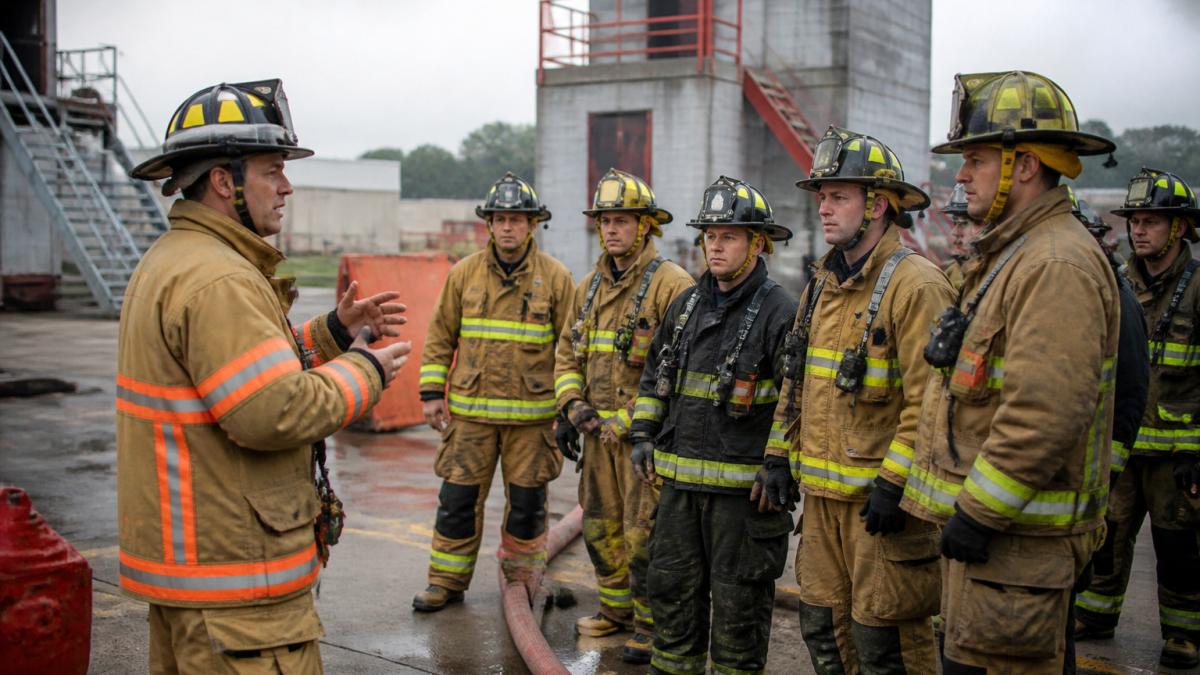
!A group of firefighters and EMTs in turnout gear listening to an instructor during a hands-on training drill at a fire station training yard
Effective field training includes:
- Scenario drills that include a hazard the crew must identify and call out
- Equipment checks performed by the crew, not just observed
- Debriefs that focus on what to change, not who made the mistake
Training also has to fit your schedule. If your team needs a structured approach to field safety, our safety consulting services for emergency responders cover how that work is organized.
Evaluating Risk Management Software and Tools
Software can help track inspections, training records, incident reports and exposure data, but it does not replace good judgment. The harder question is not which platform has the most features, it is which one your crews will actually open at 2 a.m. after a call. This section covers how to scope the tool by agency type, plan the rollout, integrate with dispatch and incident-management systems, and measure whether it is working.
Match the Tool to the Agency, Not the Brochure
Fire, EMS, police and dispatch have different record-keeping obligations and field workflows. A platform built for a career fire department with a full-time safety officer may be overbuilt for a volunteer EMS agency, and a dispatch center’s needs are mostly continuity and call-data integrity rather than apparatus inspections.
- Fire departments: prioritize apparatus checks, self-contained breathing apparatus (SCBA) and PPE tracking, hose and ladder inspection logs, and exposure reporting. NFPA 1500 and NFPA 1851 are voluntary consensus standards that apply to fire department records; confirm with your own legal and risk advisors which apply to your organization.
- EMS agencies: prioritize vehicle and equipment checks, medication and supply logs, infection-control exposure records, and driver qualification files. If your agency bills Medicare or Medicaid, records that support documentation and compliance reviews matter alongside safety records.
- Law enforcement: prioritize use-of-force reporting, vehicle pursuit and collision records, equipment issue and inspection, and officer wellness data. Sensitive records raise data-handling questions that belong in the procurement review.
Integration With Dispatch and Incident Management
The most common rollout failure is a tool that lives in a silo. Before you buy, ask how the system exchanges data with the platforms your agency already runs, computer-aided dispatch (CAD), records management systems (RMS), National Fire Incident Reporting System (NFIRS) or its successor reporting channels, and your learning management system for training records.
- Single sign-on and role-based access: crews should not need a second password to file a hazard report.
- Mobile-first capture: a hazard report or apparatus check should be submittable from a phone or rugged tablet in under two minutes.
- Export formats: confirm you can export records in a format your auditor, insurer or attorney can read without vendor help.
Implementation, Ownership and Adoption
A software purchase is a change-management project. Assign a named owner, often the safety officer or a deputy chief, and a small working group with at least one frontline user from each shift. Pilot with one station or crew, fix the friction points, then expand. Budget time for training and treat the first 90 days as a learning period, not a compliance deadline.
Common mistakes we see:
- Buying on a demo without a trial using your own data.
- Skipping the frontline user in selection, then wondering why adoption stalls.
- Assuming the vendor’s default templates match your agency’s policies.
Measuring Whether the Tool Is Working
Set evaluation criteria before you buy, and review them at 6 and 12 months. Useful measures include:
- Time to submit a hazard report or apparatus check.
- Percentage of scheduled inspections completed on time.
- Percentage of training records current for each responder.
If those numbers do not improve, the tool is not the problem, the workflow is. For equipment requiring formal operator qualification, confirm any tracking system is backed by actual training records and employer authorization. Our safety consulting services for emergency responders can help scope and select tools that fit your agency’s real workflow.
Ask every vendor for a written data-export sample and a security summary before you sign. If they hesitate, that is your answer.
Scheduling Your Next Risk Review with Scomac Associates
A risk review is most useful before a problem, not after one. If your department has not reviewed its hazard assessment or emergency response plan in the past year, start now with the checklist and plan template, then decide where outside input would help.
At Scomac Associates LLC, we work with fire, EMS, towing and industrial teams to close the gap between written policy and field reality. To see the course options available, visit our training certification courses page, then contact us to schedule a risk review tailored to your operation.
Frequently Asked Questions
What does risk management mean for emergency services?
Risk management for emergency services is the ongoing process of identifying hazards, assessing how likely and severe each one is, and putting controls in place to reduce harm to responders and the public. It covers operational risks such as vehicle response, scene hazards, patient handling, and staffing gaps. Unlike a one-time audit, it runs continuously and feeds into written procedures, training, and incident review. Agencies that treat it as a living process rather than a binder on a shelf are better positioned to defend their decisions after an incident.
What should an emergency response risk management plan include?
A practical plan usually includes a hazard inventory, a risk rating method, assigned owners for each control, written response procedures, a training schedule, and a method for reporting near misses and incidents. It should also name who approves changes and how often the plan is reviewed. An emergency response safety plan template can give structure, but the content has to reflect your own apparatus, staffing, and service area. Generic language that does not match daily operations is a common weakness.
How often should an emergency response risk management plan be reviewed?
Most agencies review the plan on a fixed annual cycle and also after any significant incident, equipment change, new service area, or shift in staffing. Review should confirm that hazards are still accurately listed, that controls are being used in practice, and that training matches current procedures. Documenting each review, including who attended and what changed, strengthens your record if the plan is questioned later. A review that happens only when someone remembers it leaves gaps.
