

Quick Summary
To implement consistent safety protocols, run a hazard assessment at every site and shift, write a short checklist for each high-risk task, train every shift the same way, verify procedures in the field, and keep document control tight. Updating protocols after each incident keeps them current.
- Run a hazard assessment at each location, including after-hours and weekend work.
- Keep each task checklist to one page with clear pass or fail checks.
- Deliver the same core training on every shift and confirm skills with a supervisor.
- Use weekly, monthly and quarterly reviews to track observation and injury indicators.
- Update procedures and retrain affected shifts after every incident or near miss.
Table of Contents
- Why Safety Protocols Drift Across Shifts and Locations
- Step 1: Conduct a Workplace Hazard Assessment
- Step 2: Write a Safety Procedure Checklist for Each Task
- Step 3: Deliver Safety Training for Employees on Every Shift
- Step 4: Verify Procedures Are Followed in the Field
- Step 5: Document Training and Compliance Records
- Step 6: Update Protocols After Incidents and Near Misses
- Getting Your Safety Protocols Reviewed by Scomac
- Frequently Asked Questions
Why Safety Protocols Drift Across Shifts and Locations
Safety protocols rarely fail on paper. They fail in the gap between the written procedure and what actually happens on a night shift, at a second yard, or on a job site three hours from the office.
Protocol drift happens for predictable reasons:
- Different supervisors interpret the same rule differently. One shift lead requires a chock block; another treats it as optional.
- Training happens once, then fades. New hires get a briefing, and nobody checks what they retained.
- Written procedures are outdated. Equipment changes, vehicles change, and the procedure stays the same.
Consistency is not about more rules. For a deeper guide on keeping safety consistent across multiple shifts, see the steps for each part of that process.
Step 1: Conduct a Workplace Hazard Assessment
Start with what actually happens at each location and on each shift. Once hazards are identified, a practical guide to emergency response risk management plans can help you plan for the emergencies they could trigger. A hazard assessment identifies the tasks, equipment, and conditions that create risk, then ranks them so your effort goes where it matters most.
How to run it:
- List every task performed at each site, including after-hours and weekend work.
- Walk each location with the people who do the work, not only the managers.
- Note where hazards differ by shift, such as lighting, staffing levels, or fatigue.
Your hazard list becomes the foundation for every procedure that follows.
Step 2: Write a Safety Procedure Checklist for Each Task
Once you know the hazards, write a safety procedure checklist for each high-risk task. A checklist turns a general rule like “secure the load” into specific actions a worker can confirm before, during, and after the task.
What a Usable Checklist Includes
A checklist that gets used is short, specific, and written in the language of the people doing the job. It should include:
- The task name and the site or equipment it applies to
- Required personal protective equipment
- Each step in order, with a clear pass or fail check
Keep each checklist to one page. Post it where the work happens, and keep a controlled copy in your document system so everyone works from the current version.
Step 3: Deliver Safety Training for Employees on Every Shift
Training is where most protocols either stick or die. A single orientation session on Monday day shift does nothing for the driver who works Friday nights.
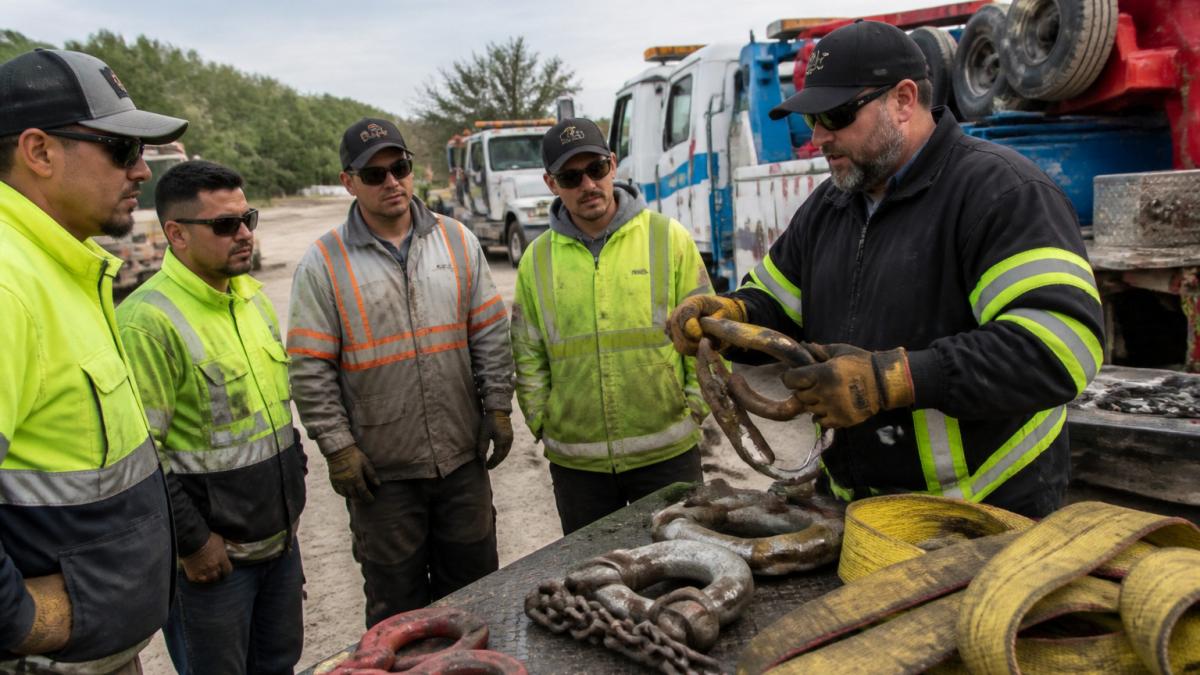
Make training consistent across shifts:
- Use the same core content and the same hands-on demonstration for every shift.
- Schedule sessions so night and weekend staff can attend, or deliver them at the start of their shift.
- Have a qualified supervisor confirm each employee can perform the task, not only sit through the lesson.
The ideal format for each topic depends on how the skill is learned. You can compare hands-on and online safety training to decide which format fits each topic. Hands-on instruction works best for equipment operation and securement, while a short online module can cover policy background.
Step 4: Verify Procedures Are Followed in the Field
Training shows what people should do. Verification shows what they actually do, and whether the protocol is holding across shifts, sites, and crews. The mistake most operations make is treating verification as an occasional walk-through. A repeatable verification system has three parts: defined observations, measurable indicators, and a fixed review cadence with named owners.
Define What You Are Observing
Start with a short observation protocol for each high-risk task. A supervisor watches the task against the checklist and records:
- Which critical steps were performed, missed, or performed out of order
- Whether required PPE was in use
- Whether the worker could explain the reason for each critical step
Keep observations brief and routine. A five-minute observation at the start of a shift is more useful than a quarterly inspection, because it catches drift before it becomes a habit.
Track Leading and Lagging Indicators
Consistency improves when it is measured. A practical indicator set separates what predicts problems from what records them.
Leading indicators (early signals):
- Observation completion rate, percentage of scheduled observations actually performed
- Critical-step compliance rate, percentage of observed tasks with all critical steps completed
- Training currency, percentage of employees current on required initial, refresher, and evaluation requirements
Lagging indicators (outcomes):
- Recordable injury and illness rates, tracked against your own baseline
- Near-miss reports and their investigation status
- Repeat findings from audits or inspections
Use your own historical data as the baseline. Industry averages can provide context, but they are not a substitute for knowing your own trend line.
Set a Review Cadence With Named Owners
Measurement only changes behavior when someone is accountable for acting on it. A workable cadence for most operations:
- Weekly: supervisors review observation findings with their crews and correct on-the-spot issues.
- Monthly: the safety lead reviews indicator trends, closes or escalates open corrective actions, and flags procedures that keep generating findings.
- Quarterly: leadership reviews the full indicator set, confirms training currency, and approves procedure revisions.
Assign a named owner to each indicator and each corrective action. “The safety committee” is not an owner; a specific role is.
Close the Loop With Workers
Verification fails when workers see it as a gotcha. Share what was observed, what changed as a result, and which procedures were revised. When a pattern of missed steps appears, the first question should be whether the procedure is hard to follow, not whether the worker cares.
A protocol is only consistent if you can show, month over month, that it is being followed and that findings are being acted on. Observations, indicators, and a fixed review cadence turn verification from an occasional event into a management system.
If you need help building an observation protocol, selecting indicators that fit your operation, or setting up a review cadence your supervisors can sustain, a safety program review can put the measurement system in place and connect it to your training and documentation.
The table below summarises the three parts of a repeatable verification system and the review cadence the article recommends.
| Review level | Frequency | What it covers |
|---|---|---|
| Supervisor review | Weekly | Observation findings, corrected on the spot with crews |
| Safety lead review | Monthly | Indicator trends, open corrective actions, recurring procedure gaps |
| Leadership review | Quarterly | Full indicator set, training currency, procedure revisions |
| Field observation | Start of shift | Critical steps, PPE use, worker explanation of each step |
| Lagging indicators | Ongoing | Injury rates, near-miss reports, repeat audit findings |
Step 5: Document Training and Compliance Records
Documentation is where consistent protocols either hold together or fall apart. A procedure that exists in three versions across two yards is not a standard, it is a guess about which one is current. The goal of document control is simple: any worker, supervisor, or inspector should be able to confirm which version of a procedure was in effect on any given date, who was trained on it, and when it was retired.
Build a Controlled Document Set
Treat every safety procedure, checklist, and training record as a controlled document. At minimum, each one should carry:
- A unique document ID and title
- The revision number and effective date
- The name or role of the approver
A common pattern is a simple numbering scheme (for example, SEC-004 Rev. 3) that lets supervisors reference a specific version in a toolbox talk or audit finding without ambiguity.
Control Distribution and Access
Paper binders drift. The most reliable approach is a single controlled master, a shared drive, intranet page, or document management system, where only designated administrators can publish new revisions. From that master:
- Print or post only the current revision at the point of use.
- Mark printed copies with the revision number and a “verify against master before use” note.
- Remove superseded copies from binders, trucks, and job trailers on the day the new revision takes effect.
For multi-site operations, a short distribution log showing which locations received which revision closes a common audit gap.
Capture Acknowledgments
Training records and procedure acknowledgments answer different questions. Training records show what was taught; acknowledgments show that the employee received and understood the current version of a specific procedure. Keep both, and tie each acknowledgment to the document ID and revision number so the record stays meaningful after the procedure changes.
Keep Records Audit-Ready
A practical record set for each employee and each protocol includes:
- Training dates, topics, instructor, and evaluation results
- Signed acknowledgments tied to specific document revisions
- Field observation and audit findings
Retention periods vary, and some standards set their own recordkeeping requirements. Confirm what applies to your operation rather than assuming a single retention period covers everything.
A quick self-check: pick any active procedure and ask a supervisor at each location to produce the current revision and the last three employees’ acknowledgments. If any location cannot, the document control system is not yet working.
If your binders, shared drives, and training files have grown faster than your ability to control them, a documentation review can map what you have, identify outdated or duplicate procedures, and set up a controlled master your supervisors can actually maintain.
Step 6: Update Protocols After Incidents and Near Misses
Every incident and near miss is information about how your protocol is failing. Treat each one as a prompt to review the procedure, not only the individual involved.
After each event, ask:
- Was the hazard identified in our assessment?
- Did the checklist cover this step clearly?
- Was the employee trained on it, and when?
Then update the procedure, retrain the affected shifts, and record the change. For a deeper walkthrough, read our guide to reducing near-miss incidents for drivers. Protocols that improve after each event become stronger over time, while those left untouched drift further from reality.
Getting Your Safety Protocols Reviewed by Scomac
If your protocols look consistent on paper but drift in practice, an outside review can show you where the gaps are. Scomac Associates LLC works with towing, emergency response, and industrial operations to review written procedures, test them against real job site conditions, and build training that fits your crews and shifts.
We can help you assess your hazards, tighten your checklists, and set up a verification process your supervisors can run. Contact Scomac Associates LLC to request a safety program review and a practical plan for your operation.
Frequently Asked Questions
How do you implement safety protocols in the workplace?
Start with a hazard assessment to identify what can go wrong in each task. Then write a procedure for each high-risk task, train every employee who performs it, verify that the procedure is followed in the field, and keep records of training and corrective actions. Assign one owner to each protocol so someone is accountable for keeping it current. Review the protocols on a set schedule and after any incident or near miss.
What is the difference between a safety policy and a safety procedure?
A safety policy is a high-level statement from management that sets the organization’s commitment to safety, assigns responsibilities, and states expectations. A safety procedure is the specific, step-by-step method for performing a task safely, such as lockout/tagout or securing a load. Policies explain why and who; procedures explain how. Both need to be written down, communicated, and reviewed on a regular schedule.
How often should employees receive safety training?
Initial training must happen before an employee performs a task, and Retraining is generally expected when a worker’s job changes, when new hazards are introduced, or when an incident shows the employee is not following procedures. Many employers also schedule annual refreshers for high-risk work. Check the specific OSHA standard that covers your tasks, since some standards set their own retraining triggers and frequencies.
What should a workplace safety protocol include?
A usable protocol identifies the task and the hazards it involves, lists required personal protective equipment and tools, gives numbered steps, states who is responsible for each step, and explains what to do when something goes wrong. It should also name the document version and date so employees know they are using the current copy. Keep the language plain and the steps short enough that a worker can follow them without reading the whole document.
