
Last Updated: November 8, 2026
Quick Summary
Improving towing safety culture starts with visible leadership commitment, not a new policy manual, because culture is what leadership tolerates. Build short, towing-specific policies and briefings drivers actually follow, remove blame from incident reporting, and audit on a fixed schedule. Track leading indicators like near-miss reports and completed pre-trip inspections rather than waiting for crashes.
- Owners and managers wear PPE in the yard every time and attend safety meetings instead of delegating them.
- Run three tiers: a daily shift-start briefing, a weekly crew huddle, and a monthly program review.
- Separate the reporting process from discipline for honest mistakes so drivers report near misses.
- Audit monthly, quarterly, and annually, with findings tracked to an owner and due date.
- Keep a laminated checklist in every truck covering coupler, lights, tires, straps, and load limits.
Table of Contents
- Start With Leadership Commitment, Not a New Manual
- Build Towing Safety Policies Drivers Can Actually Follow
- Towing Safety Meeting Topics That Keep Crews Engaged
- Towing Driver Incident Reporting Training That Removes the Blame
- Run a Towing Fleet Safety Audit on a Fixed Schedule
- Put a Towing Safety Checklist in Every Truck and Every Bay
- Measure Safety Culture With Leading Indicators
- Request a Safety Program Review for Your Towing Operation
- Frequently Asked Questions
Start With Leadership Commitment, Not a New Manual
Most towing companies try to fix safety culture by buying a binder. They order a policy manual, hand it out, and wait for behavior to change. It doesn’t.
Culture is what leadership tolerates. If a supervisor ignores a missing pre-trip inspection because the truck needs to roll, drivers learn that speed beats safety.
Make leadership commitment visible and specific:
- Owners and managers wear PPE in the yard, every time
- Supervisors stop a job when conditions are unsafe, and say why
- Leadership attends safety meetings instead of delegating them
Leadership behavior reaches a small crew quickly, which makes it one of the most direct levers a small operation has. If you’re building a program from scratch, how small towing fleets build safety training walks through a practical starting path.
Build Towing Safety Policies Drivers Can Actually Follow
A policy nobody follows is worse than no policy. It teaches drivers that rules are decorative.
Write policies in the language of the job.
Build policies around what drivers actually do:
- Pre-trip inspection steps, in order
- Hookup and load securement procedures
- Weight limits and towing capacity checks before dispatch
Get driver input before you finalize anything. For a step-by-step structure you can adapt, see improving your towing safety protocols.
Watch out: policies copied from another company’s manual often reference equipment and job types your fleet doesn’t run.
Towing Safety Meeting Topics That Keep Crews Engaged
Safety meetings fail when they become a reading of last month’s incident report. Crews tune out, and the meeting turns into paperwork.

The woman is American.
Short, focused briefings beat long monthly sessions. Ten minutes at shift start, one topic, real examples. Rotate through topics like these:
- A near miss from the past month, discussed without naming anyone
- Load securement: one hookup walked through step by step
- Distracted driving and phone use in the cab
Ask questions instead of lecturing. “What would you do if the coupler won’t latch at 2 a.m. on a shoulder?” gets more engagement than any slide.
Build a Meeting Cadence, Not a Monthly Event
One long monthly meeting cannot carry a safety culture. Most towing operations that make meetings stick run three tiers:
- Daily shift-start briefing (5-10 minutes): one hazard, one reminder, one question. The dispatcher or shift lead runs it, not the owner.
- Weekly crew huddle (20-30 minutes): review the week’s near misses and inspection findings, walk through one procedure, and confirm corrective actions are closing.
- Monthly program review (45-60 minutes): leadership attends, trends from leading indicators are shared, and one policy or procedure gets stress-tested against real jobs.
The daily briefing is where culture actually lives. It is also the easiest to let slide when dispatch gets busy, which is exactly when it matters most.
Make Each Topic Towing-Specific
Generic topics produce generic meetings. Anchor each session to a scenario your crews will actually face:
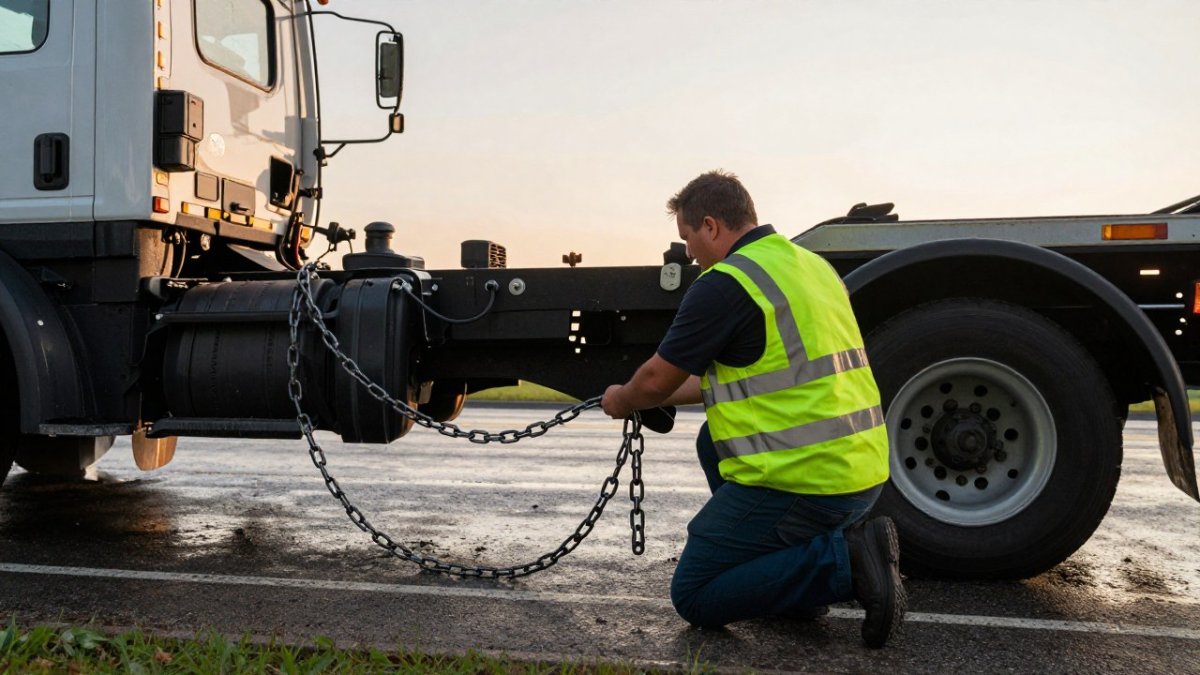
- Hookup failure at night: coupler not fully latched, safety chains crossed and attached, breakaway cable routed correctly, lights verified with a walk-around before rolling
- Load shift on a curve: how weight distribution and tie-down count change on a grade or off-camber turn, and what the driver should feel and do
- Roadside recovery positioning: truck angle, cone placement, warning lights, and where the operator stands relative to traffic
Assign Roles So Meetings Do Not Depend on One Person
A meeting program that depends on the owner showing up dies when the owner is on a call. Assign responsibility across the operation:
- Owner or general manager: attends the monthly review, funds training, and visibly backs the stop-work authority supervisors need
- Safety director or designated safety lead: owns the cadence, builds the topic calendar, and tracks attendance and follow-up
- Dispatchers: run the daily briefing, flag route and weather hazards before dispatch, and reinforce that a delayed tow is cheaper than a failed one
Keep a Topic Calendar and Rotate Ownership
Build a rolling 12-week topic calendar and assign a different presenter each week. Drivers who present a topic prepare for it, and preparation is where the learning happens. Keep a simple log of date, topic, presenter, and attendance so you can show the program is real when a customer, insurer, or auditor asks. If your crews need structured instruction on the underlying procedures, customized employee safety training can fill the gaps a briefing cannot.
Towing Driver Incident Reporting Training That Removes the Blame
The biggest barrier to incident reporting is fear. Drivers stay quiet because they expect punishment, and unreported near misses become next year’s crashes.
Build reporting training around one message: we need the information, not a culprit. Then back it up.
- Separate the reporting process from discipline for honest mistakes
- Let drivers report near misses without a written reprimand
- Thank people publicly for reporting, even when the report is about their own error
Train drivers on what to report, how, and how fast. Documentation also protects the company and the driver when something serious happens, which is why incident defensibility strategies pair naturally with reporting training.
Watch out: saying “no blame” while a supervisor quietly writes someone up destroys trust in one conversation. Consistency matters more than the policy language.
Define What Counts as a Report
Drivers stay silent when the categories are fuzzy. Spell them out:
- Near miss: an event that could have caused injury, damage, or a crash but did not, a coupler that popped loose on a test pull, a strap that slipped, a close call merging with a load
- Hazard observation: a condition found before anything happened, worn chain links, a cracked light housing, a soft shoulder at a regular pickup point
- Minor incident: property damage, a dropped load, a wheel lift failure, a customer vehicle damaged during hookup
Make clear that near misses and hazard observations are the most valuable reports, because they are the cheapest place to learn.
Build a Reporting Process Drivers Will Actually Use
A process that requires a long form after a 12-hour shift will not get used. Keep it short and multi-channel:
- A one-page paper card kept in the cab for quick capture
- A phone or tablet form with the same fields, submitted before end of shift
- A direct line to the safety lead for anything urgent
Capture only what you need: what happened, where, when, what equipment was involved, what the driver did, and what could have prevented it.
Close the Loop So Drivers See It Matter
Reporting dies when nothing happens after a report. Every report needs a visible response:
- Acknowledge receipt within one shift
- Assign a corrective action with an owner and a due date
- Share the outcome at the next weekly huddle, without naming the reporter
When drivers see a strap failure report turn into a fleet-wide inspection of that strap model, they learn that reporting changes something. That is what makes the next report happen.
Protect the Reporter and the Report
No-blame only works if it is real. Separate the reporting channel from the disciplinary file, keep reports confidential to the safety lead and leadership, and train supervisors on the difference between an honest mistake and willful disregard. A driver who reports their own hookup error should be treated differently from a driver who repeatedly skips the hookup check and hides it. Making that distinction part of driver safety training helps turn honest reporting into a consistent habit rather than a judgment call.
Train the Reporting Skill, Not Just the Policy
Drivers often don’t report because they’re not sure what they saw or how to describe it. Run short scenario drills: show a photo of a worn strap or a partially latched coupler and ask the crew to write a two-line report, then review them together. If your team needs a structured starting point, a safety program review can assess whether your reporting process is actually reaching the people closest to the hazard.
Run a Towing Fleet Safety Audit on a Fixed Schedule
A towing fleet safety audit is a scheduled review of vehicles, equipment, records, and driver practices against your own policies and applicable requirements. It finds problems before a roadside inspection or a crash does.
Put audits on the calendar and keep them there:
- Monthly: spot-check a sample of trucks, hitches, straps, and chains
- Quarterly: review inspection records, training completion, and incident reports
- Annually: full program review, including policy updates and refresher training needs
Assign one person to own the schedule, and rotate which trucks get checked so nobody knows in advance. A ready-to-use towing risk assessment checklist makes the field portion faster and more consistent.
Put a Towing Safety Checklist in Every Truck and Every Bay
Checklists work because they remove memory from the equation. A driver at hour eleven of a long shift shouldn’t have to recall every step from training.
Keep the checklist short enough to actually get used:
- Coupler latched and pinned, safety chains crossed and attached
- Lights, turn signals, and brake lights working
- Tires inspected, including the spare, with proper pressure
Laminate it, mount it in the cab, and replace it when it wears out. Bay checklists cover the shop side: equipment inspection, maintenance sign-off, and corrective actions from the last audit.
Measure Safety Culture With Leading Indicators
Most fleets measure safety by counting crashes. That’s a lagging indicator, and by the time it moves, someone is already hurt.
Leading indicators tell you where you’re heading:
| Indicator | What It Tells You | Review Frequency |
|---|---|---|
| Near-miss reports submitted | Whether drivers trust the reporting process | Monthly |
| Pre-trip inspections completed | Whether daily checks are real or pencil-whipped | Weekly |
| Safety meeting attendance | Whether briefings reach the whole crew | Monthly |
| Corrective actions closed on time | Whether audit findings get fixed | Monthly |
| Training completion by driver | Where refresher training is overdue | Quarterly |
| Driver safety suggestions raised | Whether the crew feels heard | Quarterly |
Track a handful of these, not twenty. Share the numbers with drivers so they see progress. A rising near-miss count early on is usually good news: it means reporting is working.
Request a Safety Program Review for Your Towing Operation
Culture change stalls when nobody outside the operation takes a hard look at it.
Scomac Associates LLC provides practical, field-tested safety training and risk management for towing operations.
If your program lives in a binder and not in the yard, that’s the place to start.
Your drivers already know which procedures get skipped under pressure. A program review turns that knowledge into a plan you can act on.
Frequently Asked Questions
What are the best ways to improve safety culture in a towing company?
Start with visible leadership: owners and managers who follow the same rules they set for drivers. Then make training regular and specific to towing work rather than generic online courses, run short safety meetings that cover real calls from the past week, and make near-miss reporting easy and blame-free. Measure the program with leading indicators such as inspection completion and meeting attendance, not just incident counts. Each of these steps reinforces the others, which is why culture improves fastest when they run together.
How should towing companies encourage drivers to report near misses?
Remove the fear of punishment for reporting. Separate the reporting process from discipline, and state in writing that a driver who reports a near miss in good faith will not be penalized for the report itself. Keep the form short, allow verbal reports to a supervisor, and close the loop by telling crews what changed because of what they reported. Towing driver incident reporting training should explain the difference between a near miss, a property-damage incident, and a recordable injury so drivers know what to log.
How can managers measure safety culture in a towing fleet?
Track leading indicators alongside lagging ones. Useful leading measures include pre-trip inspection completion rates, safety meeting attendance, near-miss reports per driver per month, corrective actions closed on time, and training completion by role. Lagging measures such as incident rates still matter, but they tell you what already went wrong. Review both sets monthly, and watch the trend rather than any single month’s number, since small fleets produce noisy data.
What safety training should towing operators receive?
Training should cover pre-trip and post-trip inspection, load securement and weight distribution, hitching and coupling, tire condition and pressure, roadside positioning and traffic exposure, distracted and impaired driving awareness, and incident reporting procedures. Supervisors need additional training on conducting audits and investigations. Refresher training and documented operator evaluation should follow on a schedule, and new hires need onboarding before they work unsupervised. Requirements vary by operation and by the regulations that apply to your vehicles, so confirm what is mandatory for your fleet.
