
Last Updated: October 25, 2026
Quick Summary
Hands-on safety training puts workers in real situations with actual equipment where an instructor demonstrates technique, corrects mistakes immediately, and confirms competency under pressure. Online training delivers knowledge efficiently at the worker’s own pace, but knowledge alone is not competency, OSHA standards requiring demonstrated ability or evaluation cannot be satisfied by online modules alone.
- OSHA standards explicitly requiring demonstration, evaluation, or hands-on practice, such as powered industrial truck operation, fire extinguisher use, and respirator fit testing, cannot be satisfied by online training alone.
- Online training excels at delivering foundational knowledge, regulatory updates, and policy content efficiently across multiple shifts and locations without operational disruption.
- A defensible training program documents competency assessment through observation checklists signed by a qualified evaluator, not completion certificates alone.
- Blended training, online instruction followed by hands-on practice and supervised assessment, is the most effective approach for high-risk tasks.
- The decision between online and hands-on formats must be made task by task based on what the applicable standard requires and the consequence of error.
Table of Contents
- The Core Difference: Hands-On Safety Training vs Online Learning
- When Hands-On Practice Is Essential
- What Online Training Does Well
- OSHA Online Training Requirements and Compliance Limits
- Building Your Safety Training Checklist
- Measuring Safety Training Effectiveness After Delivery
- The Blended Approach: Combining Online Instruction with Live Practice
- Getting Started with a Competency-Based Training Plan
- Frequently Asked Questions
The Core Difference: Hands-On Safety Training vs Online Learning
Choosing between hands-on safety training and online learning isn’t either-or. Both formats serve real purposes but deliver different outcomes.
Hands-on safety training puts workers in real situations with actual equipment, where an instructor demonstrates technique, corrects mistakes immediately, and confirms workers can perform under pressure. Online training delivers knowledge efficiently, at the worker’s own pace, without disrupting operations.
The critical difference: knowledge isn’t competency. A driver can pass an online course on rigging procedures and still freeze when a vehicle is suspended over a pit.
When Hands-On Practice Is Essential
Certain safety tasks cannot be learned from a screen. These are the ones where mistakes cause injuries or fatalities.
Tasks That Require Skill Demonstration
Rigging and load securing demand hands-on practice.
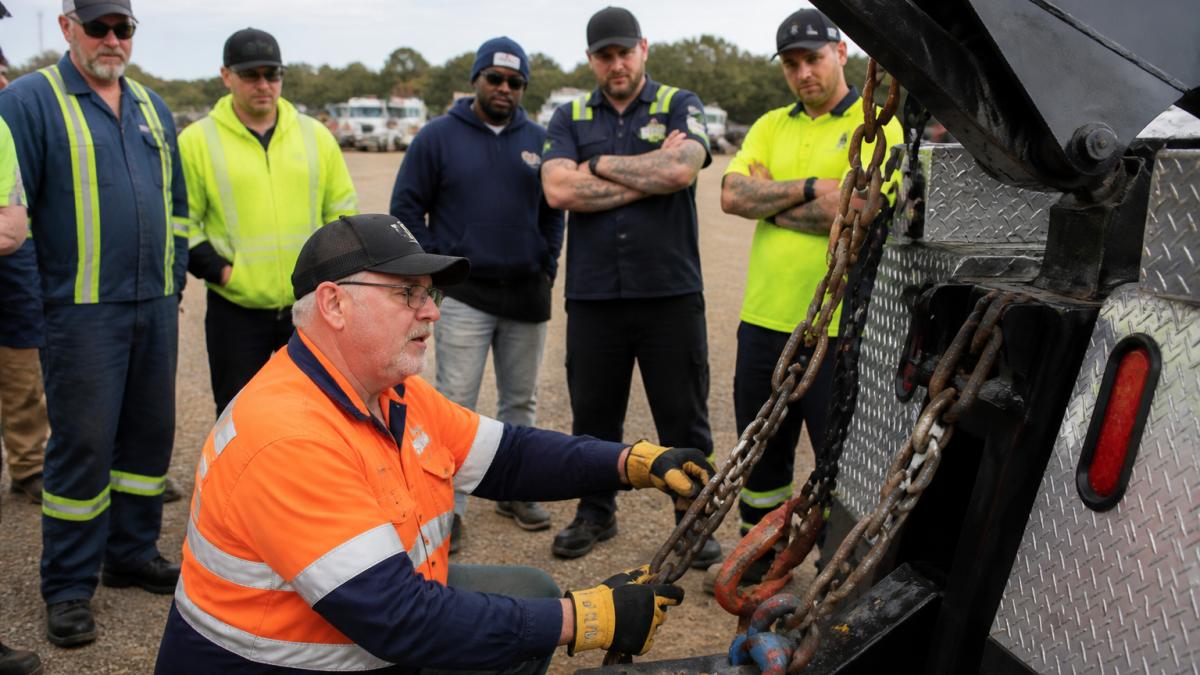
Vehicle recovery operations are the same.
Hazard recognition in field conditions also requires hands-on exposure.
Emergency response procedures benefit from hands-on drills. A firefighter who has practiced equipment deployment, ladder angles, and rescue techniques under controlled stress performs better when real emergencies happen.
Safety Training for Towing Operators and Field Staff
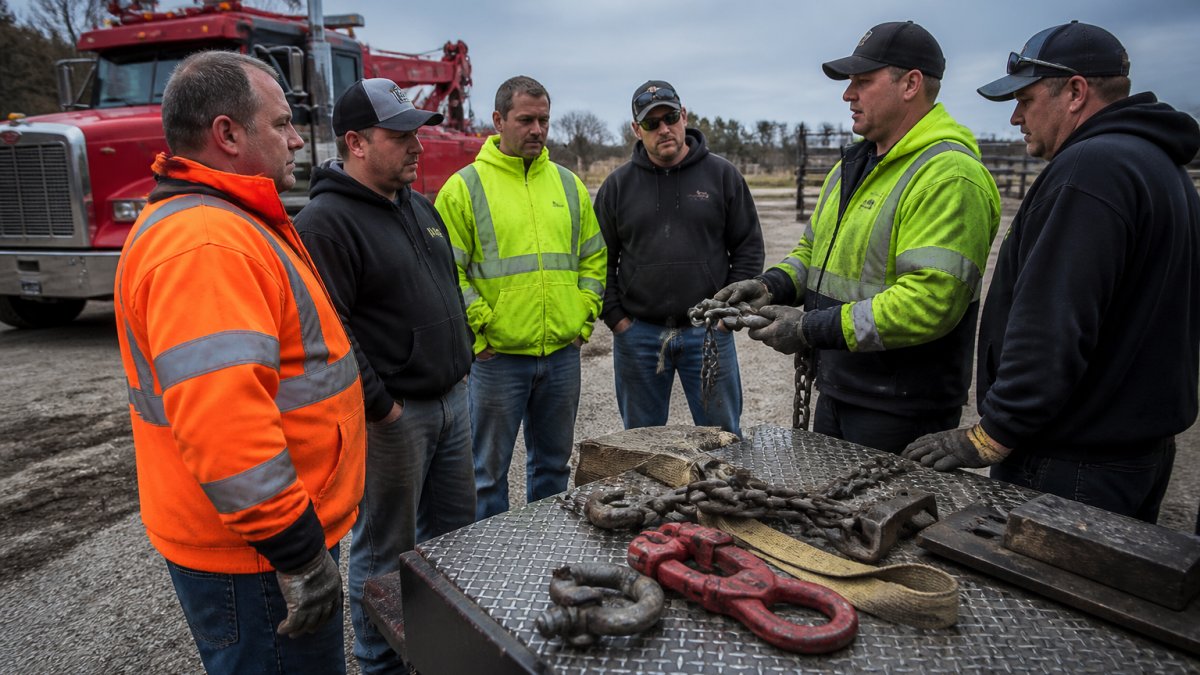
Towing operations present specific hazards that demand hands-on safety training. Hook positioning, weight distribution, and vehicle stability during recovery are physical realities trainees need to experience.
Towing-specific driving practices are the same. Handling a loaded trailer, braking distances, and backing procedures develop through supervised practice; online modules explain the principles but can’t replace the repetition and correction that builds safe habits.
What Online Training Does Well
Online training excels at delivering knowledge efficiently, ideal for foundational information, regulatory updates, and content workers need to reference later.
Online training also solves logistical problems. With crews on different shifts across multiple locations, classroom training is expensive and disruptive.
Online content also costs less per employee than instructor-led classroom training, and platforms create training records automatically, documentation that matters for compliance and defensibility.
The retention challenge with online-only training is real: workers complete a course and forget the details weeks later.
OSHA Online Training Requirements and Compliance Limits
OSHA does not approve, certify, or endorse safety training courses, and it does not publish a list of approved online providers. What OSHA publishes is a set of standards describing what training must accomplish, usually in performance language rather than prescribing a delivery method.
That distinction is the whole ballgame when deciding between online and hands-on formats.
What the Standards Actually Say
Several OSHA standards are explicit that training must result in demonstrated understanding or demonstrated ability, not merely attendance. A few examples:
- Hazard communication (29 CFR 1910.1200(h)) requires training on the hazards of chemicals in the workplace and the measures employees can take to protect themselves. The standard does not dictate format, but it does require that employees understand the information.
- Powered industrial trucks (29 CFR 1910.178(l)) is the clearest example. It requires formal instruction, practical training, and an evaluation of the operator’s performance in the workplace. The standard states that training shall consist of a combination of formal instruction (which may include a lecture, discussion, interactive computer learning, video, and written material), practical training (demonstrations and exercises performed by the trainee), and evaluation of the operator’s performance in the workplace. Online modules can satisfy part of the formal instruction. They cannot satisfy the practical training or the workplace evaluation.
- Lockout/tagout (29 CFR 1910.147(c)(7)) requires training in the energy control procedure and, for affected and other employees, training in the purpose and function of the energy control program. The standard ties training to the specific procedures at your site, which is hard to deliver generically online.
Notice the pattern. Where the standard says ‘understand,’ online can carry the load. Where the standard says ‘demonstrate,’ ‘evaluate,’ or ‘perform,’ online alone cannot.
The Employer’s Assessment Obligation
A common compliance mistake is treating a completion certificate as proof of competency. It is not. The certificate proves the worker sat through the content, not that they can perform the task safely.
For any task where the standard requires evaluation or demonstration, the employer needs a record showing that someone qualified observed the worker perform the task and judged the performance acceptable, identifying the evaluator, date, task, and criteria used.
This is also where employer authorization enters the picture. Many standards separate training from authorization to operate.
Where Online Training Fits and Where It Doesn’t
Online training is a legitimate and often efficient way to deliver the formal instruction component of many OSHA-required programs.
The practical rule: read the standard for each task you train on, identify whether it requires demonstration or evaluation, and build your program to satisfy that requirement.
For guidance on structuring training to prevent violations, see OSHA Violation Prevention for Industrial Firms.
OSHA does not certify training providers or issue training certificates. Any provider that implies OSHA approval of its course is misrepresenting the relationship. What matters is whether your training satisfies the specific standard that applies to the task.
Building Your Safety Training Checklist
A training plan that works is built task by task, not course by course. The most useful tool for choosing between online and hands-on formats is a simple matrix that sorts each task by risk and by whether the standard or the job requires demonstrated performance.
The Task-by-Task Decision Matrix
For each task your workers perform, answer three questions:
- Does a standard require demonstration, evaluation, or hands-on practice for this task? If yes, hands-on is mandatory, not optional.
- Does a mistake in this task cause serious injury or fatality? If yes, hands-on practice and assessment are strongly indicated even where the standard is silent.
- Is the task primarily knowledge-based, with errors caught before harm? If yes, online instruction can carry most or all of the training.
Applied to common tasks, the matrix looks like this:
| Task | Standard requires demonstration or evaluation? | Consequence of error | Recommended format |
|---|---|---|---|
| Powered industrial truck operation | Yes, 29 CFR 1910.178(l) | High | Online formal instruction + hands-on practical training + workplace evaluation |
| Fire extinguisher use (employees expected to fight incipient fires) | Yes, 29 CFR 1910.157(g) | High | Online hazard education + hands-on discharge practice |
| Respirator use | Yes, fit testing under 29 CFR 1910.134(f); training under (k) | High | Online content + hands-on fit testing and donning/doffing practice |
| Lockout/tagout procedure application | Training required under 29 CFR 1910.147(c)(7); site-specific | High | Online concepts + hands-on practice on your equipment |
| Rigging and load securement for towing | Depends on applicable DOT/FMCSA requirements and cargo securement rules | High | Online principles + hands-on rigging practice with instructor correction |
| Vehicle recovery operations | Largely employer-defined; high-risk | High | Hands-on with supervised scenarios |
| Hazard communication | Training required under 29 CFR 1910.1200(h); understanding required | Moderate | Online acceptable; verify understanding |
| Bloodborne pathogen awareness | Training required under 29 CFR 1910.1030(g)(2) | Moderate | Online acceptable for awareness; hands-on for tasks with exposure control |
| Emergency action plan familiarization | Training required under 29 CFR 1910.38(e) | Varies | Online for plan content; drills for execution |
| Incident reporting procedures | Employer-defined | Low to moderate | Online acceptable |
Two cautions about the table. First, the standards cited are examples, not a complete list, and applicability depends on your operations and the tasks your employees actually perform. Second, ’employer-defined’ does not mean the training is optional, it means the employer sets the competency bar and is accountable for whether workers can perform safely.
Separating Knowledge, Skill, and Authorization
A second checklist item that trips up many employers is conflating three different things:
- Knowledge, the worker understands the hazard, the procedure, and why it matters.
- Skill, the worker can perform the task correctly under real conditions.
- Authorization, the employer has decided the worker is cleared to perform the task independently.
Online training can build knowledge. Hands-on training builds skill. Authorization is an employer decision that follows demonstrated competency. A program that stops at knowledge and calls it done has skipped two of the three.
Assessing Competency After Training
Completion is not competency. The only way to know whether a worker can perform a task safely is to observe them do it and judge the performance against defined criteria.
A workable competency assessment has four components:
- A task list with observable criteria. ‘Can secure a load’ is too vague. ‘Selects correct chain grade and capacity for the load, attaches at designated points, tensions to specification, and verifies securement before departure’ is assessable.
- A qualified evaluator. Someone who can perform the task correctly and recognize when it is being performed incorrectly. For many tasks this is a supervisor or a designated competent person; for others it is an outside instructor.
- An observation checklist. The evaluator watches the worker perform the task and records pass or fail against each criterion. This produces a record that answers the question an investigator will ask.
- Defined pass criteria and a remediation path. What happens when a worker does not pass? Retraining, re-evaluation, and documentation of both.
For knowledge-based content, a written or online test with a defined passing score is adequate. For skills, only observation counts.
Documenting the Plan
Once the matrix is built and the assessment method is defined, document it. A training file that holds up under scrutiny typically includes:
- The task list and the training format chosen for each task, with the reason.
- The standard or employer policy that drove the choice.
- Completion records for online modules.
That file lets you answer the two questions that matter after an incident: did the worker understand the hazard, and did the worker demonstrate the ability to perform the task safely?
You can see how this approach works across multiple shifts and locations in our guide on how to Standardize Safety Across Multiple Shifts.
The decision between online and hands-on is not made once for the whole company. It is made task by task, based on what the standard requires and what the consequence of error is. Build the matrix, define competency in observable terms, and document the assessment.
Measuring Safety Training Effectiveness After Delivery
Training that doesn’t reduce incidents isn’t actually working. Start by establishing a baseline: near-miss counts, incident rate, and the most common error types before training. After training, track the same metrics. Increased near-miss reporting can mean workers are more aware of hazards, or that incidents are rising, so context matters.
For detailed guidance on measuring training effectiveness across your operation, see how near-miss reduction connects to driver safety outcomes.
The Blended Approach: Combining Online Instruction with Live Practice
The most effective safety programs use both online and hands-on training strategically. Online training delivers foundational knowledge, regulations, hazard categories, and safe procedures, at the worker’s own pace without disrupting operations.
For towing operations, this might look like: online training on load securement regulations and principles, followed by hands-on practice rigging different vehicle types.
Blended training also works for refresher cycles.
You’re using online training for efficient knowledge delivery and hands-on training for skill development and competency verification.
Getting Started with a Competency-Based Training Plan
Building a training program that actually improves safety starts with one decision: measure competency, not just completion. Too many programs stop at completion, workers finish a course, get a certificate, and the training is “done,” creating a false sense of security.
Scomac Associates LLC works with towing operations, fire departments, and industrial employers to build training programs structured around actual job demands. That field-tested approach bridges the gap between written policies and real-world operations.
Frequently Asked Questions
Is hands-on safety training better than online training?
Neither is universally better, the answer depends on the task and your workforce. Online training excels at building knowledge and hazard awareness across distributed teams quickly. Hands-on safety training is essential when workers must demonstrate physical skills, make real-time decisions under pressure, or perform tasks where mistakes create immediate risk. The strongest approach combines both: use online instruction to establish foundational knowledge, then require hands-on practice and competency assessment for high-risk tasks.
Can online safety training meet OSHA requirements?
OSHA does not mandate a specific delivery format for most training, but OSHA online training requirements depend on the standard. Many OSHA standards require employers to ensure workers are trained and competent, without specifying how. However, standards covering confined spaces, fall protection, and hazard communication often require demonstration and evaluation. Check the applicable standard for your industry. Online courses alone typically satisfy knowledge requirements but not competency verification. Document what format you used and why it fits your hazards.
Which safety topics require hands-on practice?
Any task where incorrect performance creates immediate injury risk should include hands-on practice: rigging and load securing, vehicle operation, rescue procedures, equipment assembly, and emergency response. Workers must practice under supervision, receive feedback on their technique, and demonstrate competency before performing the task independently. Knowledge-only training (online or lecture) is insufficient for these high-risk tasks. Use online modules to teach the ‘why’ and ‘what,’ then schedule hands-on sessions to teach the ‘how’ with real feedback.
How do you know if workers actually learned from safety training?
Completion of a course is not proof of learning. Assess safety training effectiveness through competency evaluation: observe workers performing the task, check their understanding of hazards and procedures, and document their demonstrated ability before they work independently. Use a safety training checklist that includes pre-training assessment, knowledge tests, hands-on demonstration, and post-training observation. Track near-misses and incidents after training to identify gaps. Refresher training should target areas where workers struggle, not repeat what they already know.
The choice between hands-on and online training isn’t about which format is better overall. It’s about which format solves your specific safety challenges. Use online training where it works, knowledge delivery and compliance documentation. Use hands-on training where it matters most, skill development and competency verification. Combine them strategically, and you build a program that actually reduces incidents and improves operational safety.
