
Last Updated: November 2, 2026
Quick Summary
A towing safety consultant reviews how a towing company works in the field and the office, then helps the owner build written standards covering driver practices, roadside procedures, equipment, recordkeeping and training. The goal is a program that holds up on a job site and during an audit.
- Roadside procedures should cover scope, pre-arrival actions, on-scene setup, work execution, stop-work criteria and post-scene actions.
- Write procedures for the worst realistic condition, such as a rain-soaked curve at night.
- Include stop-work criteria so drivers have explicit permission to wait for law enforcement or more resources.
- Keep training records separate from employer authorization for each recovery method.
- Run an internal mock audit at least once a year to find problems before an auditor does.
Table of Contents
- What a Towing Safety Consultant Actually Does
- Roadside and Scene Safety Procedures That Need Written Standards
- DOT Compliance Checklist for Towing Companies
- OSHA Requirements for Towing and Recovery
- FMCSA Safety Audit Preparation
- Tow-Truck Equipment Inspection and Maintenance Records
- Choosing a Towing Safety Consultant and Measuring Results
- Frequently Asked Questions
What a Towing Safety Consultant Actually Does
A towing safety consultant reviews how a towing company works in the field and in the office, then helps the owner build written standards around it.
Many towing operators assume a consultant simply hands over a binder. If you are comparing options, see alternatives and how to choose a towing safety consultant for a side-by-side look at what to ask for.
A typical engagement includes:
- Reviewing existing safety policies, driver files and incident reports
- Identifying hazards in roadside and yard operations
- Mapping gaps against applicable federal and state requirements
Roadside and Scene Safety Procedures That Need Written Standards
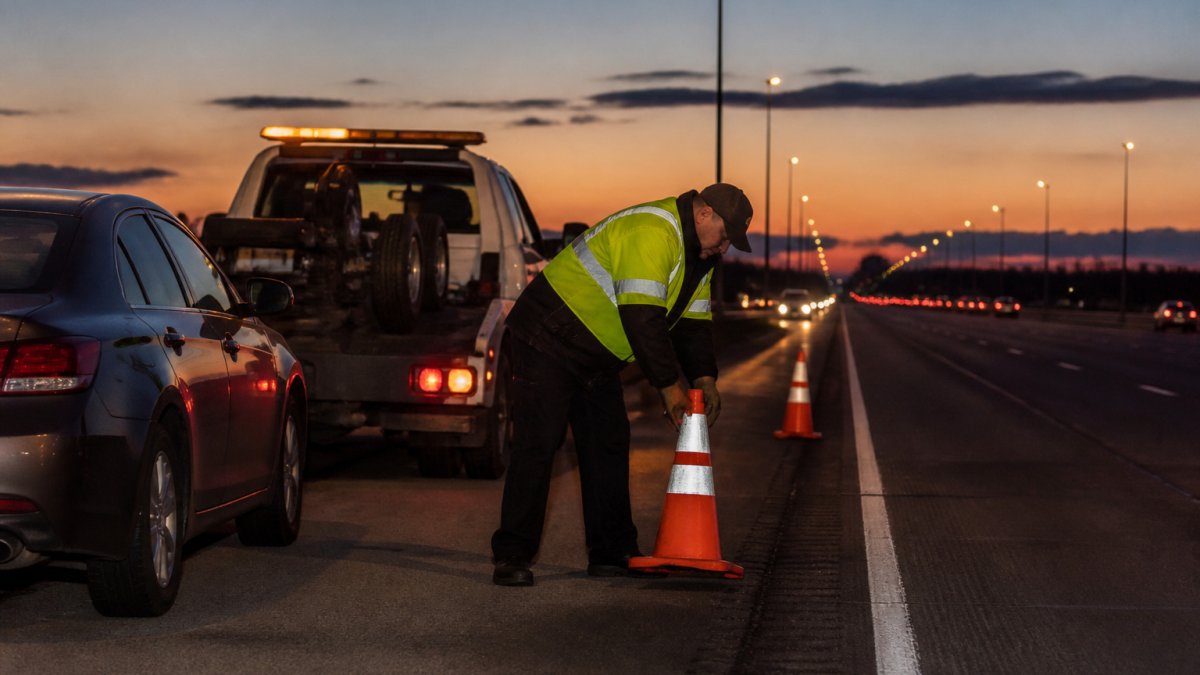
Roadside work is where towing crews face the hazard that most other industries do not: moving traffic feet away from a person on foot. The written procedure has to answer the questions a driver faces before the truck stops, and it has to be specific enough that a supervisor can train against it and an investigator can see what the company expected.
The hazards the procedure must address
- Traffic exposure and secondary collisions. The greatest risk on a shoulder is a passing vehicle striking the tow operator, the customer, or the tow truck. Procedures should address where the operator stands relative to traffic, when to work from the protected side of the vehicle, and when to stop work entirely until traffic is controlled.
- Scene positioning. Where the tow truck parks determines how much protection the scene has. Positioning considerations include blocking the lane adjacent to the disabled vehicle where law and conditions allow, angling the truck to deflect traffic, and keeping the operator out of the live lane during hookup.
- Visibility and warning devices. Warning devices, high-visibility apparel, and truck lighting work together. Procedures should specify what gets deployed, in what order, and at what distance, and should account for night, rain, fog, and curve or crest conditions where sight distance is short.
What a usable written procedure looks like
A procedure that survives an incident review has four parts: the condition it applies to, the required actions in order, the stop-work criteria, and the record that shows the employee was trained on it. Keep each procedure short enough to be read on a phone at the scene, and keep the full version in the safety manual.
A practical structure for each procedure:
- Scope, which vehicle types, road types, and conditions it covers.
- Pre-arrival actions, what dispatch and the driver confirm before arrival.
- On-scene setup, positioning, warning devices, apparel, and lighting in sequence.
- Work execution, the recovery steps and the safety checks between them.
- Stop-work criteria, the specific conditions that require stopping, such as traffic volume, weather, or an unstable load.
- Post-scene actions, device retrieval, incident reporting, and equipment inspection.
Training and documentation
A procedure that exists only in a manager’s head cannot be trained, audited, or defended. For a practical step-by-step guide to improving towing safety protocols, start with the procedures that matter most on the road.
Watch out: a procedure written for ideal conditions will be abandoned the first time a driver faces a rain-soaked curve at night. To see how these written standards fit into broader incident planning, read towing company incident defensibility strategies.
Scomac Associates LLC provides towing-specific policy development and hands-on training. If your roadside procedures exist only as habits, request a safety program review to discuss putting them in writing.
The table below condenses the four parts of a usable written procedure, so a supervisor can see what each section must contain at a glance.
| Part | What it covers | Where it is used |
|---|---|---|
| Scope | Vehicle types, road types, and conditions covered | Safety manual |
| Pre-arrival actions | What dispatch and the driver confirm before arrival | Dispatch and driver |
| On-scene setup | Positioning, warning devices, apparel, and lighting in sequence | Scene |
| Work execution | Recovery steps and safety checks between them | Scene |
| Stop-work criteria | Specific conditions that require stopping | Scene and supervisor |
| Post-scene actions | Device retrieval, incident reporting, and equipment inspection | Post-job |
DOT Compliance Checklist for Towing Companies
Towing companies that operate commercial motor vehicles fall under Federal Motor Carrier Safety Administration (FMCSA) rules, which govern driver qualification, hours of service, vehicle inspection and maintenance. The exact requirements depend on vehicle weight, cargo, and whether the operation is interstate or intrastate, so verify your obligations against the current federal regulations at FMCSA regulations and guidance.
A practical checklist for internal review:
- Driver qualification files are complete and current
- Drivers’ hours of service are logged and reviewed
- Vehicle inspection and maintenance records are on file
Common mistakes include letting driver files lapse between renewals and treating inspection records as optional paperwork. Both are easy to fix and expensive to ignore.
OSHA Requirements for Towing and Recovery
The Occupational Safety and Health Administration (OSHA) regulates employee safety in the workplace, including many towing yard and roadside activities. OSHA standards cover general duty obligations, hazard communication, personal protective equipment, and training.
Relevant areas often include:
- Hazard communication for chemicals used in cleaning or fluid handling
- Personal protective equipment for roadside and yard work
- Fall and struck-by hazards during recovery operations
Whether a given standard applies depends on your operations and your state’s enforcement program. Review the requirements at OSHA standards and workplace safety resources and confirm with a qualified professional before relying on any single interpretation.
FMCSA Safety Audit Preparation
An FMCSA safety audit or compliance review examines whether a carrier’s records and practices meet federal requirements. Keeping audit records current also makes it easier to verify DOT inspection requirements before a review exposes gaps.
Practical preparation steps:
- Pull records for drivers, vehicles and maintenance for the past several months.
- Check that each file has the required documents and that none are expired.
- Confirm hours-of-service logs match dispatch and fuel records.
- Walk the yard and a sample of vehicles to check condition against your own written standards.
- Assign one person to coordinate the audit and to be the point of contact.
We recommend running an internal mock audit at least once a year, because the findings from a self-review usually point to the same problems an auditor would raise. A how-to on standardizing safety across multiple shifts can help make those practices consistent before the audit arrives.
Tow-Truck Equipment Inspection and Maintenance Records
Tow trucks carry winches, booms, wheel-lift hardware, chains, straps and lighting. Each of these can fail in service, and each one falls under the company’s maintenance responsibilities. Records matter because they show a regular inspection routine rather than a reaction to a failure.
A workable records system should capture:
- Pre-trip and post-trip inspection checklists signed by the driver
- Date, mileage or hours for each scheduled service
- Repairs performed, parts used and the technician’s name
Many small operators keep this information on paper and lose it. A simple spreadsheet or fleet management system with one owner is usually enough.
Choosing a Towing Safety Consultant and Measuring Results
Most towing owners have never hired a safety consultant before, so the selection process itself is where engagements go wrong. A consultant who is strong on general workplace safety but has no towing field experience may write a program that looks complete and fails in the field. Treat the selection process as a structured evaluation rather than a conversation about price.
A step-by-step buyer guide
- Define the scope in writing before you call anyone. Decide whether you need a program built from scratch, a gap assessment against current requirements, training delivery, mock-audit support, or help after a citation or crash. A consultant cannot price or staff an undefined engagement, and a vague scope is the most common source of scope creep.
- Ask about towing and recovery experience specifically. General trucking or warehouse safety experience does not transfer automatically. Ask which recovery methods the consultant has worked around, light-duty, medium-duty, heavy-duty, rotator, and which roadside environments (interstate shoulder, urban curb, rural two-lane, private lot).
- Verify credentials against the actual work. Relevant backgrounds include Certified Safety Professional (CSP) or Associate Safety Professional (ASP) credentials from the Board of Certified Safety Professionals, Certified Industrial Hygienist (CIH) where exposure assessment is in scope, and documented FMCSA and OSHA subject knowledge (Certified Safety Professional® (CSP®)). Ask for the specific regulation numbers the consultant works from, not just the agency names.
- Ask how findings will be documented. Request a sample deliverable, a gap report, a written procedure, a training roster. You want to see whether the output is usable by a supervisor or is a binder that never gets opened.
- Confirm how training will be delivered and recorded. Ask whether training is classroom, hands-on, online, or blended, who delivers it, and what record each employee receives. Remember that OSHA does not certify or endorse training; the record that matters is your company’s own documentation of who was trained, on what, by whom, and when.
- Clarify availability and response time. A consultant who is four hours away is not useful for a same-day scene review after a serious incident. Ask about response windows, after-hours availability, and how urgent questions are handled between scheduled visits.
- Ask what happens after the engagement ends. A good consultant leaves your supervisors able to run the program without them. Ask what training-of-trainers support, templates, and follow-up reviews are included.
Questions to put in writing
- Which specific FMCSA and OSHA requirements will you assess us against, and how will you handle state-plan differences?
- How will you distinguish mandatory legal requirements from voluntary consensus standards and industry best practices in your report?
- Who on your team will actually do the fieldwork, and what are their qualifications?
Watch out: a consultant who promises guaranteed compliance or elimination of liability is overpromising. No engagement can deliver either, and a proposal that makes those claims is a warning sign about the rest of the work.
Measuring safety program outcomes
The second half of a good engagement is measurement. Set the measures at the start so progress is visible rather than assumed. Useful indicators for a towing operation include:
- Recordable incident rate and lost-time rate, tracked the same way each period so trends are comparable.
- Near-miss reporting volume. A rising count early in a program is usually a sign that reporting is working, not that safety is worsening.
- Roadside incident count, separated by cause (traffic strike, equipment failure, recovery failure, slip/fall) so you can see which procedure is failing.
Scomac Associates LLC provides practical, field-tested safety training and risk management solutions for towing and recovery operations. If you are evaluating consultants or want a second opinion on an existing program, request a safety program review or a consultation to discuss scope and deliverables.
Frequently Asked Questions
What is DOT compliance for commercial towing vehicles?
DOT compliance for commercial towing vehicles means meeting the Federal Motor Carrier Safety Regulations (FMCSRs) that apply to the trucks and drivers you operate. Requirements typically cover driver qualification files, hours of service, vehicle inspection and maintenance, and drug and alcohol testing where it applies. Which rules apply depends on your vehicle weight rating, whether you cross state lines, and how you operate. A consultant can map your specific operation to the regulations that govern it so your written program matches what you actually do on the road.
Do towing companies need an OSHA safety program?
OSHA does not require a single document called a safety program, but it does require employers to protect workers from recognized hazards under the General Duty Clause and to comply with specific standards that apply to the work. Towing operators often face hazards such as traffic exposure, hydraulic equipment, and winching loads. Many employers document these hazards and their controls in a written program because it helps them train workers consistently and show what they did if an incident is investigated.
How often should towing companies conduct safety audits?
No federal rule sets one fixed audit frequency for every towing company. Internal reviews are usually scheduled at least annually, and additional reviews after incidents, equipment changes, or new hires are common practice. Your frequency should reflect your fleet size, incident history, and the risk of the work you perform. A consultant can help you set a schedule and document each review so the record supports your program.
How can a safety consultant help a towing company prepare for an FMCSA audit?
A consultant can run a mock audit against the FMCSA review areas, check driver qualification files, hours-of-service records, maintenance records, and inspection history, and flag gaps before an auditor does. They can also help you build corrective action plans and train staff on what records must be available. Preparation is most effective when it is ongoing rather than a scramble the week before a scheduled review.
