
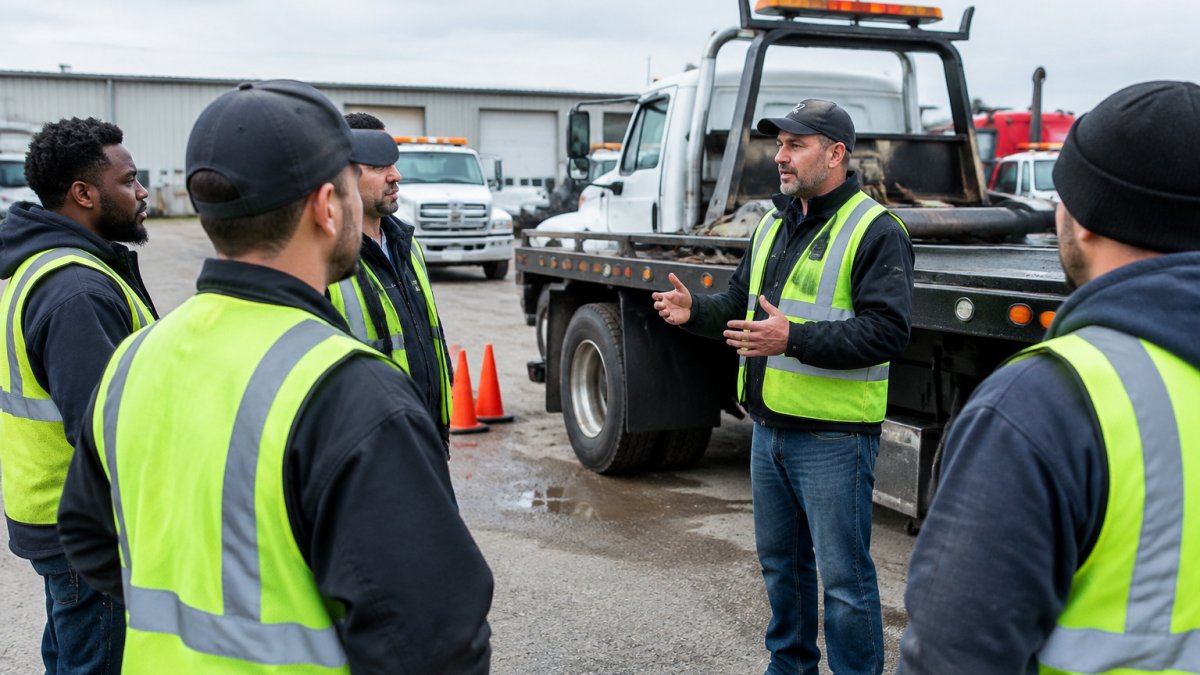
Quick Summary
A small towing fleet builds safety training by writing a plan tied to its own work, a repeatable schedule, and records that prove who was trained on what. The plan should list the highest-risk tasks, sequence onboarding before solo calls, and use short monthly talks with quarterly hands-on sessions. Documented sign-offs turn safety intentions into evidence.
- Write a one-page plan answering who, what, by whom, how often, and how it is recorded
- Require documented sign-offs for supervised scene setup before any solo call
- Hold a short monthly toolbox talk and a quarterly hands-on skills session
- Rotate hands-on sessions across shifts so the whole fleet is never off the road
- Track near misses and renewal dates to show whether training is working
Table of Contents
- Why Safety Training for Small Towing Fleets Needs Its Own Plan
- Roadside Safety Training for Tow Truck Drivers: What Must Be Covered
- Building a Fleet Safety Training Plan Template for a Small Operation
- Role-Specific Training for Drivers, Dispatchers and Supervisors
- A Towing Safety Training Checklist You Can Use This Week
- Structuring a Fleet Driver Safety Training Program on a Low Budget
- Keeping Training Records and Checking Whether It Works
- Bring Your Fleet Training to Scomac Associates LLC
- Frequently Asked Questions
Last Updated: November 4, 2026
Safety training for small towing fleets is not the same job as training a large carrier’s drivers. A fleet with 15 trucks rarely has a safety department, a training budget or a conference room big enough to gather everyone at once. Yet the risks are just as real: roadside work, struck-by exposure, winching and load securement, and a steady flow of traffic passing inches away.
The short answer is that a small fleet needs a written plan, a repeatable schedule, and a way to prove who was trained on what. Those three pieces turn general safety intentions into something a driver can follow on a Tuesday night and an owner can defend later. The sections below walk through how to build that plan without a dedicated safety staff.
Why Safety Training for Small Towing Fleets Needs Its Own Plan
Most safety guidance is written for large employers with full-time safety directors. Small towing operators usually inherit that advice and try to shrink it down. The result is often a binder nobody reads.
A smaller fleet needs training built around its own operations: the trucks it runs, the roads it works, and the people who actually answer the calls. Start by listing your recurring tasks, such as hookups, winch pulls, scene setup and night dispatch. Then decide which of those tasks carry the most risk.
- Identify the three tasks where a mistake would most likely hurt someone
- Note which drivers perform those tasks and how often
- Write down what you already do well so you keep it
Treat this list as the foundation of the plan. Everything else builds on it.
Roadside Safety Training for Tow Truck Drivers: What Must Be Covered
Roadside work is where most towing injuries happen. Drivers are working beside moving traffic, often at night, with limited space to maneuver. Training should cover scene setup, positioning, and how to protect yourself from passing vehicles.
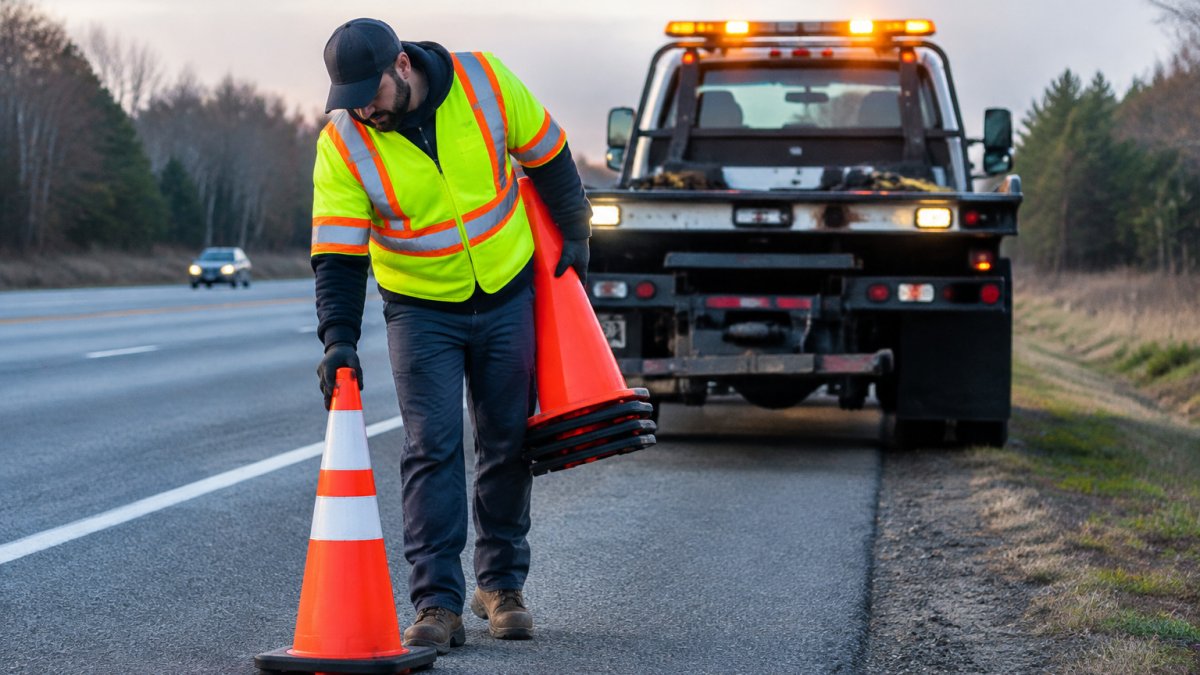
A practical roadside module covers:
- Positioning the truck to shield the work area
- Placing cones and warning devices in the correct order
- Using high-visibility clothing and working lights
- Recognizing when a scene is too dangerous to work
Check your state’s move-over requirements and the Manual on Uniform Traffic Control Devices (MUTCD) published by the Federal Highway Administration, which sets standards for traffic control at work zones. Confirm your current obligations with the relevant authority before you rely on any specific rule.
Building a Fleet Safety Training Plan Template for a Small Operation
A plan does not need to be long, but it does need to be specific enough that a dispatcher can schedule against it and a new hire can follow it.
Start with a one-page plan that answers five questions: who is trained, on what, by whom, how often, and how it is recorded. Outside help is available through towing-specific safety consultation. Then attach a schedule to it. A workable structure for a small fleet looks like this:
1. Define the scope and the roles. List every position that touches a roadside scene or a truck: drivers, dispatchers, shop staff, supervisors, and the owner who occasionally drives. Each role gets its own training line, because a dispatcher’s risks are not a driver’s risks.
**2.
3. Set a recurring cadence that fits the schedule. Most small fleets find a quarterly rhythm works better than an annual marathon.
4. Name the delivery method for each topic. General awareness topics, hazard recognition, incident reporting, fatigue, can be delivered through short online modules or a supervisor-led review.
5. Build the record before the first session. Every training event should produce a dated entry with the topic, the trainee, the instructor or supervisor, the method, and a sign-off.
A simple template to adapt:
Fleet Safety Training Plan
- Scope: All drivers, dispatchers, shop staff and supervisors
- Core topics: Roadside scene setup, move-over practices, winching and rigging, load securement, pre-trip inspection, incident and near-miss reporting
- Onboarding: Policy review, supervised inspection, supervised daylight scene setup, supervised night or low-visibility scene setup, all signed off before solo work
- Recurring cadence: Monthly toolbox talk, quarterly hands-on skills session, annual refresher, plus a review after any incident or near miss
- Delivery: Online or supervisor-led for awareness topics; hands-on with company equipment for skills topics
- Records: Date, topic, trainee, instructor, method, and sign-off for each event
- Review: Revisit the plan every six months and after any serious incident Because shop staff are part of the training plan, training shop technicians in safe inspection and equipment handling helps keep the same standards in place beyond the roadside.
Watch out: a plan that lists topics but never assigns a date, an owner or a sign-off is the most common failure point.
If an incident or near miss happens, do not wait for the next scheduled session.
Role-Specific Training for Drivers, Dispatchers and Supervisors
One training track rarely fits everyone. Drivers need hands-on skills. Dispatchers need to know how to route calls safely and what to tell a driver about road conditions. Supervisors need to spot unsafe habits and document corrections.
- Drivers: Scene setup, winching, load securement, and pre-trip inspections
- Dispatchers: Safe call assignment, weather and traffic alerts, and check-in procedures
- Supervisors: Observation, coaching, and incident documentation
Short, role-based sessions usually work better than one long course for everyone.
A Towing Safety Training Checklist You Can Use This Week
You do not need to overhaul everything at once. Use this checklist to start this week:
- List your three highest-risk tasks
- Confirm each driver has current roadside training
- Walk through one scene setup with a driver in daylight
- Review the pre-trip inspection form with your crew
- Write down one near miss from the last month and what you changed
- Set a date for the next refresher session
Small steps like these build a habit of safety that outlasts any single course.
Structuring a Fleet Driver Safety Training Program on a Low Budget
Budget limits are real, but they do not rule out good training. Compare hands-on and online delivery formats before committing to either. A small operation can combine a few low-cost tools:
- Use short, hands-on sessions during slow periods rather than paying for full-day courses
- Pair an experienced driver with a newer one for supervised field work
- Use online modules for general topics and reserve in-person time for winching and scene work
- Track training hours so you can show what you invested
The goal is consistency. A modest program run every quarter beats an expensive one that happens once.
Keeping Training Records and Checking Whether It Works
Records matter most when something goes wrong, an injury, a claim, an insurance review, or a regulatory inspection. For guidance on implementing consistent safety protocols across operations, see that page.
Separate the record types. Initial training, refresher training, hands-on skills evaluation, and employer authorization are different things and should be documented separately.
Track renewals before they lapse. A simple calendar or spreadsheet with a renewal date per employee per topic prevents the most common audit finding: training that was completed once and never refreshed.
Measure whether the training is working. Vanity metrics, hours delivered, courses completed, tell you what you spent, not what changed. Towing-specific indicators are more useful. Track a small set consistently rather than a large set sporadically:
- Near misses reported per month. A rising count can be a good sign early in a program, because it usually means crews trust the reporting process. A count that stays at zero for months often means people are not reporting.
- Roadside incidents and struck-by near misses. These are the events training is most directly aimed at preventing.
- Preventable crashes and damage claims. Review each one against the training content to see whether a skill gap, a procedure gap, or a supervision gap contributed.
- Pre-trip inspection completion rate. A drop here often signals fatigue, scheduling pressure, or a form that has become too long to use.
- Practical scene-setup check results. Periodically observe a driver setting up a scene and score it against your own checklist. This is the closest thing to a direct test of whether the training stuck.
- Inspection findings. If a regulator or insurer has cited something, that finding belongs in the training plan as a corrective action.
Close the loop. If the indicators do not improve, resist the urge to add more hours.
Watch out: treating a completed course as proof of competence is the most common records mistake.
The article lists the training record fields and the indicators worth tracking; this table gathers them in one place so a reader can scan what to keep and what to measure.
| Item | What to record or track | Why it matters |
|---|---|---|
| Training record | Topic, date, delivery method, instructor, sign-off | Answers who was trained, on what, and when |
| Skills evaluation | Whether the skill was demonstrated or needs follow-up | Shows competence, not just attendance |
| Renewal tracking | Renewal date per employee per topic | Prevents training from lapsing unnoticed |
| Renewal reminder | Set 30 days before each renewal | Lets you schedule around workload |
| Near misses reported | Count per month | Rising counts early often mean crews trust reporting |
| Roadside incidents | Count of incidents and struck-by near misses | Most direct measure of what training prevents |
| Pre-trip completion rate | Share of inspections completed | A drop can signal fatigue or an overlong form |
| Scene-setup checks | Score against your own checklist | Closest direct test of whether training stuck |
Bring Your Fleet Training to Scomac Associates LLC
If your fleet is ready to build or strengthen its safety training, Scomac Associates LLC can help. Scomac Associates LLC offers hands-on, practical instruction and policy development built around the work your drivers do. Contact us to discuss what a review of your current plan or customized training could include.
Contact Scomac Associates LLC to request a safety program review or to discuss customized training for your team. Pricing depends on your fleet size, locations and training needs, so reach out for a quote tailored to your operation.
Frequently Asked Questions
What safety training should towing company drivers receive?
Towing drivers should receive training on defensive driving, scene safety, work-zone and move-over practices, winching and load securement, and vehicle inspection before each shift. Training should also cover the company’s incident reporting procedure. Match the depth of each module to the tasks your drivers actually perform, since a driver who only does light-duty tows needs less winching instruction than one handling heavy recoveries. Document each module and who completed it.
How often should towing fleet drivers receive refresher training?
Refresher intervals depend on your written policy, incident history, and any applicable requirements for your operation. Many small fleets schedule an annual refresher and add short targeted sessions after a near-miss, a collision, or a change in equipment. Review each driver’s performance during ride-alongs or inspections to decide whether they need coaching sooner. Keep the schedule written so it can be shown during an audit or insurance review.
What records should employers keep for fleet safety training?
Keep a record for each driver showing the training topics covered, the date, the instructor or method used, and the driver’s signed acknowledgment. Add competency checks such as a practical winching evaluation or a written quiz. Store vehicle inspection logs and incident reports alongside training files so you can show the connection between training and operations. Retain records for as long as your insurer or applicable regulations require.
How can a small towing fleet evaluate whether its safety training is working?
Track a small set of measures before and after training, such as preventable collisions, near-miss reports, damage claims, and inspection defect rates. Look at trends over several quarters instead of single months, since small fleets can see large swings from one incident. Pair the numbers with driver feedback and supervisor observations. If a measure does not improve, adjust the content or delivery method rather than simply repeating the same course.
