
Last Updated: October 26, 2026
Quick Summary
Safety consulting services for emergency responders are advisory engagements that help fire departments, EMS agencies, towing fleets, and industrial emergency teams find operational gaps, meet regulatory requirements, and build programs that hold up under real conditions. Most engagements cover risk assessment, policy development, compliance support, training, and retained advisory support.
- A responder-specific risk assessment must examine the scene, not just the station or shop floor.
- Roadside vehicle incidents are the leading mechanism of death and injury for responders.
- Controls should follow the hierarchy of controls, with PPE as the last line of defense.
- Distinguish mandatory OSHA requirements from voluntary NFPA and ANSI consensus standards.
- Measure training completion by role and shift, plus corrective action closure time.
Table of Contents
- What Safety Consulting Services for Emergency Responders Actually Cover
- How an Emergency Response Risk Assessment Identifies Operational Gaps
- Building an Emergency Action Plan Template That Responders Will Use
- Emergency Responder Safety Training That Holds Up in the Field
- Roadside Responder Safety: Where Towing and Fire Operations Overlap
- How to Choose a Safety Consulting Provider: 7 Selection Criteria
- Measuring Consulting Outcomes and Keeping Improvements in Place
- Request a Safety Program Review for Your Response Organization
- Frequently Asked Questions
What Safety Consulting Services for Emergency Responders Actually Cover
Safety consulting services for emergency responders are advisory engagements that help fire departments, EMS agencies, towing and recovery fleets, and industrial emergency teams find operational gaps, meet regulatory requirements, and build programs that hold up under real conditions. A binder that satisfies an inspector but falls apart at 2 a.m. on a highway shoulder is not a safety program.
The scope varies by provider, but most engagements fall into five buckets: risk assessment, policy and program development, regulatory compliance support, training, and retained advisory support. These are not interchangeable line items. A policy document without hazard identification is guesswork; training without a written program has nothing to reinforce. Below, we cover seven topics, how to evaluate providers, and how to tell whether the engagement actually changed anything.
How an Emergency Response Risk Assessment Identifies Operational Gaps
An emergency response risk assessment is a structured review of the hazards, exposures, and failure points your crews face, ranked by likelihood and consequence. It is a working document that tells you where to spend limited resources first, not a checklist walkthrough.
The process typically moves through four stages:
- Hazard identification: scene-level review of traffic exposure, apparatus movement, equipment handling, and task sequencing
- Exposure analysis: which roles face which hazards, and how often
- Control review: what policies, equipment, and training currently exist to address each hazard
A common mistake is scoping the assessment to the station or shop floor and skipping the scene. For responders, the scene is the workplace.
The Hazards a Responder-Specific Assessment Must Cover
Generic workplace assessments stop at slips, trips, and lifting. Fire, EMS, rescue, and towing operations carry a different hazard profile, and an assessment that does not name these exposures is not measuring the job:
- Structural collapse and unstable scenes: fire-weakened structures, vehicle stabilization during extrication, trench and excavation rescue, and compromised overhead loads at crash scenes
- Hazardous materials exposure: unknown chemicals at vehicle incidents, clandestine drug operations, and industrial facility responses, including the need for air monitoring and appropriate PPE levels before entry
- Vehicle incidents and struck-by exposure: the leading mechanism of death and injury for roadside responders, driven by traffic intrusion, apparatus positioning, and visibility
For each hazard, the assessment should record the task, the role exposed, exposure frequency, the existing control, and residual risk after that control, turning a list of hazards into a prioritized action plan.
Matching Controls to the Hazard
Controls should follow the general-industry hierarchy applied to responder tasks. Engineering and administrative controls come before PPE, which is the last line and the easiest to lose under stress:
- Elimination or substitution: rerouting traffic, delaying entry until stabilization, or declining a response outside the agency’s capability
- Engineering controls: positive-pressure ventilation, vehicle stabilization equipment, air monitoring, and apparatus blocking angles
- Administrative controls: scene size-up protocols, two-in/two-out where it applies, rehabilitation and rotation schedules, and stop-work triggers
Where OSHA rules apply, the general duty clause and hazard-specific standards such as those for respiratory protection, bloodborne pathogens, and PPE establish mandatory requirements. Consensus standards from NFPA and fire/EMS service guidance establish best practice but are not legal obligations. An assessment should label each recommendation accordingly.
What the Deliverable Should Look Like
A usable assessment output is not a narrative report. It should give you a hazard register with ranked risks, a control recommendation for each gap, an owner, and a target date. If the provider cannot tell you which three gaps to close first, the assessment is not finished.
For a deeper walkthrough of building the resulting plan, see emergency response risk management plans.
Building an Emergency Action Plan Template That Responders Will Use
An emergency action plan template is a written framework that assigns roles, triggers, and actions for foreseeable emergencies. The template itself is easy. Getting crews to actually use it is the hard part.
Most plans fail for one of three reasons: nobody assigned ownership, the plan was written for a single scenario and never adapted, or it lives in a binder nobody opens. The fix is to build the template around decisions crews actually make under pressure.
A workable structure includes:
- Scenario triggers: what event activates the plan, stated in plain terms
- Role assignments: who does what, by position rather than by name
- Communication sequence: who notifies whom, and through which channel
Keep the written plan short enough that a supervisor can review it in a pre-shift briefing. A twenty-page document that never gets read is worse than a two-page one that gets used.
Emergency Responder Safety Training That Holds Up in the Field
Emergency responder safety training is instruction built around the tasks, environments, and decisions responders actually face, not generic workplace content repackaged for a new audience.
Three formats dominate the market, and each fits a different situation:
| Format | Best For | Main Limitation |
|---|---|---|
| Hands-on, instructor-led | Task-critical skills, new hires, mixed-experience crews | Scheduling across shifts and locations |
| Online, self-paced | Refresher content, policy acknowledgment, documentation | Weak retention for physical skills |
| Blended | Larger organizations with both needs | Requires coordination between formats |
Where OSHA or DOT rules apply, distinguish carefully between initial training, refresher training, and employer authorization to operate.
If you’re weighing delivery formats for your crews, hands-on versus online safety training covers the trade-offs in detail.
Roadside Responder Safety: Where Towing and Fire Operations Overlap
Roadside work is where towing and fire operations intersect most often, and where coordination failures do the most damage.
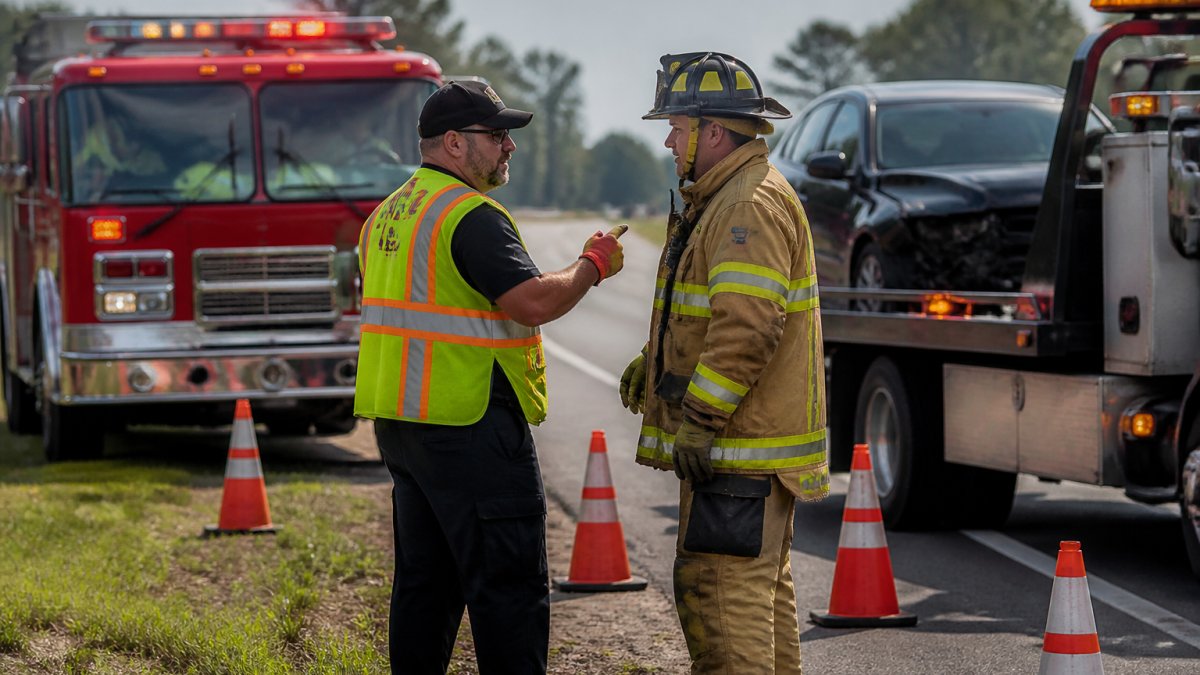
The overlap points that matter most:
- Scene control: who establishes the work zone, and how it gets communicated to arriving units
- Apparatus and vehicle positioning: blocking angles that protect the scene without creating secondary hazards
- Communication: a shared channel or protocol for two organizations that don’t share a radio system
The Manual on Uniform Traffic Control Devices sets the national standard for temporary traffic control, and it applies to incident scenes as well as work zones.
A common mistake is assuming the other agency has a plan. For driver-focused tactics on cutting near misses, see our guide to reducing near miss incidents for drivers.
How to Choose a Safety Consulting Provider: 7 Selection Criteria
Choosing a safety consultant comes down to seven criteria, and the first two eliminate most of the field. Use this checklist as a scoring sheet.
- Responder-specific experience: has the provider worked with fire, EMS, towing, or emergency response operations, or only general industry?
- Scope clarity: does the proposal state exactly what gets delivered, in what format, and by when?
- Field presence: will the work include on-scene or on-site observation, or is it document review only?
Step 1: Define the Need Before You Shop
Most bad consulting engagements start with a vague request. Before contacting providers, write down what problem you are trying to solve and what a successful outcome looks like:
- Is this driven by an incident, an inspection finding, an insurance requirement, or a planned program build?
- Which roles and locations are in scope, and which shifts?
- Do you need a written program, field observation, training, or ongoing advisory support?
A clear need statement lets you compare proposals on the same basis instead of comparing personalities.
Step 2: Vet the Provider Against the Work
Ask for examples of engagements similar in size and hazard profile to yours, and what the deliverable looked like. A provider who has only served general industry may still be capable, but you should hear how they would handle responder-specific exposures such as traffic intrusion, structural collapse, and bloodborne pathogens. Ask directly how they distinguish an OSHA requirement from an NFPA or ANSI best practice, the answer tells you whether the recommendations will be legally grounded.
Step 3: Scope and Contract the Engagement
The proposal should state the deliverable, format, schedule, personnel, and access needs. Clarify these points in writing:
- Sites and shifts covered: a single-site walkthrough is a different scope than multi-shift observation
- Field time versus desk time: how many hours on scene, and how many on document review
- Deliverable format: hazard register, written program, training materials, or briefing
Ask providers for their pricing structure in writing and what would change the scope and cost.
Step 4: Run the Engagement Well
A consultant works best when you assign an internal point of contact, make crews available for interviews and observation, and share documents up front. Brief your people on why the review is happening so it is not treated as an inspection. The most useful findings often come from the crews who do the work, and they will only surface if the engagement is framed as improvement rather than blame.
Step 5: Implement and Verify
An assessment that ends with a report has not done its job. Before the engagement closes, agree on which findings get fixed first, who owns each one, and when it will be verified.
If you’re comparing consulting approaches specific to your industry, safety consultants for towing lays out the alternatives.
Best for: organizations that want an external review before committing to a full program build.
Skip if: you need immediate on-scene coverage and have no internal supervisor capacity.
Measuring Consulting Outcomes and Keeping Improvements in Place
Measurement is where most consulting engagements quietly fail. The assessment gets delivered, the recommendations get read, and six months later nothing has changed.
Build the measurement plan before the engagement starts, not after. Four indicators give you a workable picture:
- Training completion by role and shift, not just overall headcount
- Near-miss reporting volume and closure rate, which shows whether crews trust the system
- Corrective action closure time, measured from identification to verified fix
A pattern worth watching: near-miss reports often drop after a program launch. That usually means reporting got harder or less welcome, not that incidents disappeared.
Sustaining improvements across crews, shifts, and locations is its own discipline. Standardizing safety across multiple shifts covers keeping practices consistent when your people are never in one place at one time.
Request a Safety Program Review for Your Response Organization
The hardest part of responder safety isn’t knowing what good looks like. It’s closing the distance between the written program and what happens on scene at 3 a.m. in the rain. Scomac Associates LLC provides hands-on, field-tested safety training and risk management support built for towing, emergency response, and industrial operations.
Scomac Associates LLC focuses on practical, no-fluff training. If your program needs a hard look, request a safety program review.
Frequently Asked Questions
What does a safety consultant do for emergency responders?
A safety consultant reviews how your organization identifies hazards, trains personnel, and responds to incidents. For emergency responders, that includes an emergency response risk assessment, review of policies and standard operating guidelines, mock inspections, and recommendations for corrective actions. The consultant should distinguish legal requirements, such as OSHA and FMCSA rules where they apply, from voluntary consensus standards like NFPA documents. The deliverable is usually a written program assessment with prioritized findings, not a certification. Scomac Associates LLC provides practical, field-tested safety training and risk management solutions.
What should an emergency response risk assessment include?
A useful assessment covers hazard identification by role and location, review of near-miss and incident data, evaluation of response systems and operational readiness, and interviews with personnel who perform the work. It should also examine interagency coordination, equipment readiness, and training completion records. The output should rank findings by severity and pair each with a corrective action and an owner. Ask the consultant to explain how the assessment accounts for the conditions your crews actually face, including night operations and multi-agency scenes, because a plan built for a classroom will not survive a live incident.
How often should an emergency response plan be reviewed?
Review the plan after any significant incident, near miss, or change in staffing, equipment, or jurisdiction. Many organizations also schedule an annual review and update contact lists and mutual aid agreements more frequently. The review should confirm that the emergency action plan template still matches how crews operate, not just how the manual says they should. Assign one person to own the review and record the changes. If a mock inspection or after-action review reveals a gap between the written plan and field practice, correct the plan or the practice before the next cycle.
How can towing companies improve roadside responder safety?
Start with traffic control and visibility: positioning the truck to protect the work area, wearing high-visibility apparel, and using cones, flares, or lighting according to the situation. Train drivers on scene size-up and communication with law enforcement and fire personnel. Review incident reports and near misses to find repeat problems, then fix them through policy and training rather than reminders alone. Scomac Associates LLC provides practical safety training and towing-specific policy development.
One bad incident can put a small operation out of business. The organizations that survive it are the ones whose policies, training, and documentation matched reality before the incident happened. Get started with Scomac Associates LLC and build a safety program your crews will actually follow.
