
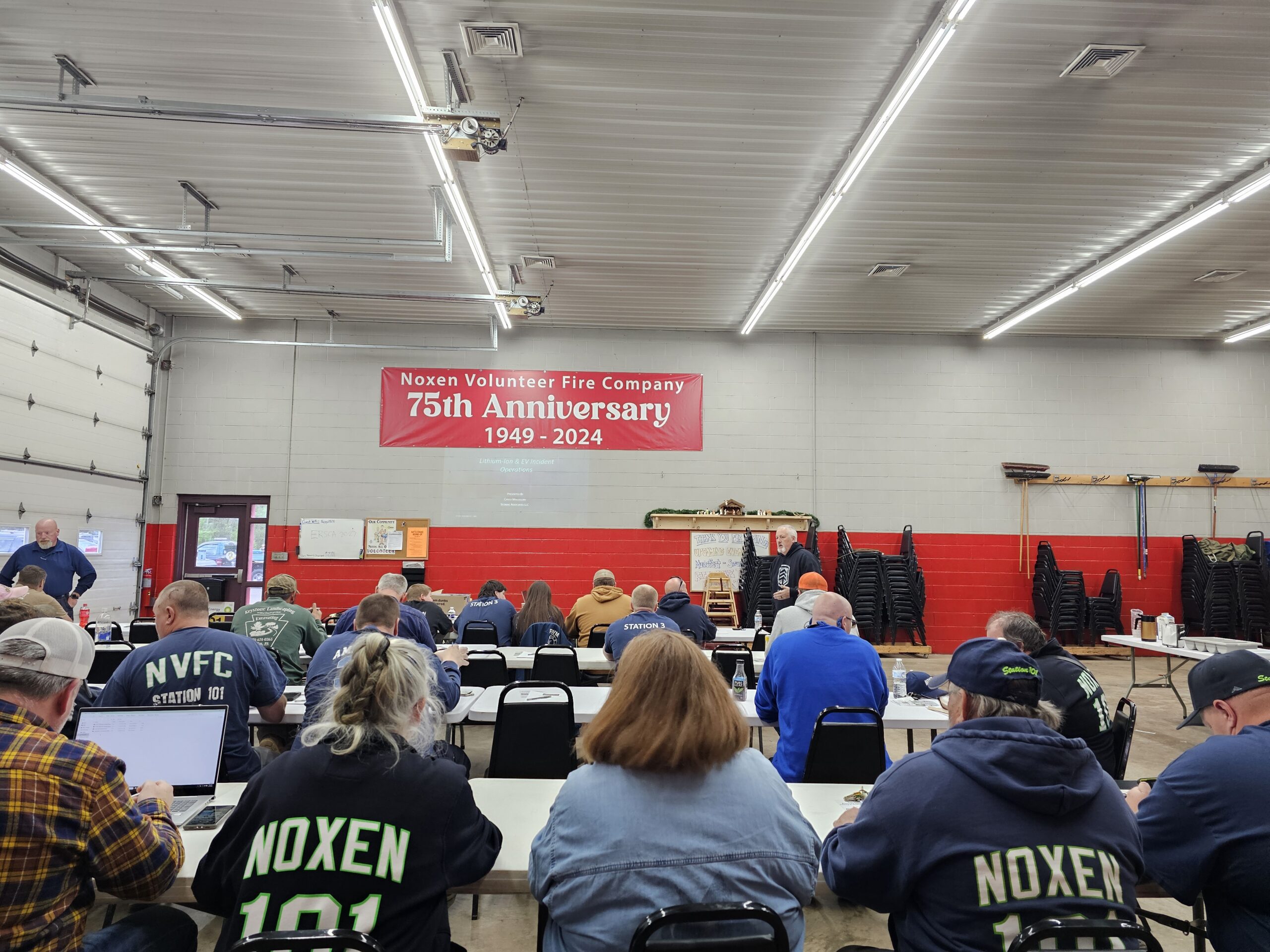
Practical EV and lithium-ion incident training built for the people who actually respond.
Lithium-Ion EV Fire Training is no longer a “someday” topic for fire departments, rescue companies, towing operators, fleet managers, and emergency responders.
Electric vehicles, hybrids, lithium-ion battery-powered equipment, e-bikes, scooters, residential charging systems, and battery energy storage hazards are already showing up in real-world incidents.
The question is not whether your department or organization will encounter this technology.
The question is whether your people will recognize the hazards early enough to make better decisions.
Scomac Associates LLC provides practical, awareness-level Lithium-Ion EV Fire Training for fire departments, towing companies, rescue organizations, transportation fleets, and emergency response teams throughout the Eastern United States.
This class is built from real-world towing, recovery, transportation, and emergency scene experience — not theory, not scare tactics, and not generic PowerPoint filler.
Serious Training. Zero Fluff.
Lithium-Ion EV Fire Training for Fire Departments and Emergency Responders
Modern emergency response is changing fast.
Firefighters and emergency responders are now being asked to identify, stabilize, manage, and make decisions around vehicles and equipment that contain high-voltage systems and lithium-ion battery packs.
That includes battery electric vehicles, plug-in hybrids, standard hybrids, commercial EVs, electric motorcycles, e-bikes, scooters, forklifts, powered industrial trucks, mobile equipment, and vehicles connected to charging systems.
Some incidents are obvious. A vehicle is on fire, smoke is showing, and crews are operating in full response mode.
Other incidents are not so obvious.
A vehicle may be involved in a crash with no visible fire. A battery compartment may be damaged. A vehicle may be partially submerged. A charging system may be involved in a residential fire. A tow operator may be asked to remove a vehicle that still has stored electrical energy.
Those are the moments where awareness matters.
Who This EV Fire Training Is For
This course is designed for organizations that may encounter electric vehicles, lithium-ion batteries, or battery-powered equipment during emergency response, towing, recovery, storage, transportation, or post-incident operations.
- Fire departments
- Rescue companies
- Emergency medical services
- Towing and recovery operators
- Heavy-duty recovery companies
- Police and traffic incident management personnel
- Fleet safety personnel
- Transportation companies
- Public works departments
- Industrial and facility safety teams
The class is especially useful for fire departments that respond to motor vehicle crashes, vehicle fires, garage fires, charging station incidents, and roadway emergencies involving electric vehicles.
It is also valuable for towing and recovery companies because tow operators are often the ones left dealing with the vehicle after the fire is knocked down and the road is reopened.
Why Lithium-Ion EV Fire Training Matters
Electric vehicles and lithium-ion battery-powered equipment bring different hazards than traditional gasoline or diesel vehicles.
That does not mean every EV incident is catastrophic.
It means responders need better recognition, better awareness, and better decision-making.
Lithium-ion battery incidents can involve stored energy, thermal runaway, delayed ignition, off-gassing, damaged battery enclosures, charging system hazards, and post-incident monitoring concerns.
Some of these hazards are visible. Some are not.
This class does not try to turn every responder into an electrical engineer.
The goal is to give responders a practical framework they can use on scene:
- Identify what they are dealing with
- Immobilize the vehicle or equipment when appropriate
- Disable systems when it can be done safely
- Manage the incident based on conditions and risk
Course Framework: Identify, Immobilize, Disable, Manage
Identify
Responders need to know how to identify electric vehicles, hybrids, charging systems, high-voltage components, and potential signs of battery involvement.
This includes badging, charging ports, orange high-voltage cabling, manufacturer markings, vehicle behavior, and emergency response guides.
Immobilize
An EV or hybrid may appear shut down but still be capable of movement or unexpected activation.
This section discusses scene safety, wheel chocking, stabilization, key control, and coordination between fire, EMS, police, and towing personnel.
Disable
Disabling is one of the most misunderstood areas of EV response.
This section explains the difference between low-voltage systems, high-voltage systems, service disconnects, emergency cut loops, and responder limitations.
One of the key messages is that “disabled” does not always mean “hazard-free.”
Manage
Management is where the incident becomes practical.
Responders discuss suppression considerations, thermal imaging, post-fire monitoring, tow operator coordination, storage concerns, and communication between agencies.
What the Class Covers
- Electric vehicle and hybrid recognition
- High-voltage system awareness
- Lithium-ion battery hazards
- Thermal runaway awareness
- Delayed ignition and reignition concerns
- Off-gassing and vapor recognition
- Charging station and residential charger hazards
- Vehicle immobilization and stabilization
- Emergency response guides
- Basic disablement concepts
- Thermal imaging camera considerations
- Vehicle isolation and storage concerns
- Towing and recovery interface
- Communication between responding agencies
- Real-world case studies and lessons learned
The course can also be adjusted based on the audience. Fire departments, towing companies, and fleet organizations all face different operational concerns.
EV Fires Are Only Part of the Problem
One of the biggest mistakes organizations make is thinking EV training is only about vehicle fires.
Many EV and lithium-ion incidents begin as something else:
- A motor vehicle crash
- A damaged battery pack
- A submerged vehicle
- A garage fire involving a charging vehicle
- An e-bike or scooter fire
- A tow yard storage concern
- A delayed reignition event
That is why this training looks beyond the flames.
Responders need to understand recognition, stabilization, scene control, stored energy, monitoring, and communication between agencies.
The Fire Service and Towing Connection
Scomac Associates brings a perspective that many EV fire training programs do not:
The towing and recovery side.
Fire departments are focused on immediate life safety, suppression, rescue, and stabilization.
But once the scene begins to transition, someone still has to move, transport, isolate, and store the damaged vehicle safely.
That is where towing and fire service coordination becomes critical.
Tow operators need to understand what firefighters are seeing and why they may be concerned.
Firefighters need to understand what tow operators are being asked to do after the scene clears.
This class helps both sides speak the same language.
Course Format
- Typical Length: 4 contact hours
- Format: Classroom-based presentation with discussion
- Delivery: On-site at your location
- Audience: Firefighters, officers, rescue personnel, tow operators, and emergency responders
- Discussion: Real-world examples, incident photos, and Q&A
- Customization: Can be adjusted for fire service, towing, fleet, or mixed audiences
The goal is discussion, recognition, and practical decision-making — not death by PowerPoint.
Why Choose Scomac Associates LLC?
Scomac Associates LLC was built from the field, not from a desk.
This course is led by Chuck MacLellan, an experienced towing, recovery, transportation safety, and training professional with more than 30 years in the industry.
Chuck’s background also includes seven years in the fire service as both a volunteer and paid firefighter, helping bridge the gap between towing, recovery, transportation, and emergency response operations.
His experience includes towing and recovery operations, heavy transport, safety program development, ERSCA instruction, EV operations training, Traffic Incident Management instruction, and fleet safety leadership.
That matters because EV and lithium-ion incidents are not just fireground problems.
They are roadway problems. They are towing problems. They are storage problems. They are communication problems.
Scomac brings those worlds together in a way that is practical, direct, and useful.
This training is built to help responders and operators make better decisions when the scene is noisy, the clock is ticking, and the risk is real.
For additional electric vehicle emergency response information, departments may also review the NFPA Emergency Response Guides .
Host a Lithium-Ion EV Fire Training Class
Scomac Associates LLC can bring Lithium-Ion EV Fire Training directly to your department, company, or organization.
Classes can be scheduled for fire departments, towing companies, emergency response organizations, municipal agencies, fleet operations, and private companies.
If your organization is starting to ask questions about electric vehicles, lithium-ion batteries, charging systems, EV fires, damaged vehicle storage, or post-incident handling, this class is a strong place to start.
You do not need to wait until the first bad incident to begin the conversation.
A few hours of practical awareness training now can help your people recognize hazards sooner and make better decisions when the call comes in.
Serving towing, transportation, recovery, and emergency services organizations throughout the Eastern United States.
Request More Information or Schedule a Class
Ready to schedule a Lithium-Ion EV Fire Training class or discuss your department’s needs?
Email:
chuck@scomacassllc.com
Phone:
(570) 899-1210
Website:
scomacassllc.com
Serious Training. Zero Fluff. #TrainingMatters
© 2026 Scomac Associates LLC. All rights reserved.
“`