
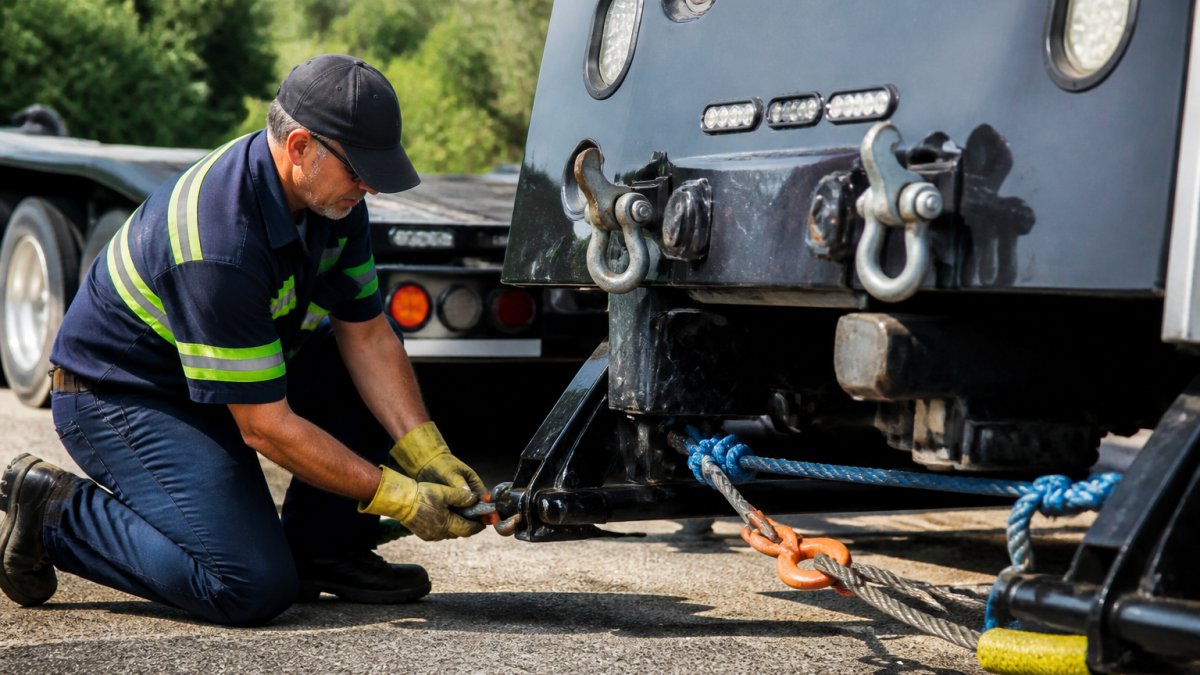
Last Updated: October 26, 2026
Quick Summary
Field tested safety solutions for towing are worth it because they are proven under actual recovery conditions, not just in a showroom. Catalog specs describe ideal conditions, while real tows add traffic, weather, grade, and damaged vehicles, so gear must survive repeated use, poor visibility, and tired drivers.
- Field testing measures the hundredth pull, after gear has been dragged, sun-cured, and run over.
- Match gear to the load path for flatbed, wheel-lift, hook-and-chain, and roadside recovery setups.
- Working load limits and breaking strengths are not interchangeable, and ratings assume undamaged, correctly rigged gear.
- Run a pre-hookup checklist and re-check tie-downs after the first mile.
- Set written retirement criteria by gear type and remove retired gear from service immediately.
Table of Contents
- Why Catalog Safety Gear Fails on a Real Tow
- What Field Testing Actually Proves About Towing Safety
- Choosing Safety Equipment by Towing Scenario
- The Towing Safety Checklist Every Operator Should Run
- Building a Tow Truck Inspection Checklist That Holds Up
- Tow Truck Driver Safety Training That Sticks
- Towing Incident Reporting and Defensibility
- Request a Safety Program Review for Your Towing Operation
- Frequently Asked Questions
Why Catalog Safety Gear Fails on a Real Tow
Field tested safety solutions for towing are products and procedures proven under actual recovery conditions, not just in a showroom. The same pattern is often seen: gear that looked fine in a catalog fails the first time a driver fights a rain-slicked highway shoulder at 2 a.m., which is why field tested safety solutions for towing matter more than spec sheets.
The gap is predictable. Catalog specs describe a product in ideal conditions. A real tow adds traffic, weather, grade, and a damaged vehicle that refuses to roll.
- Straps rated for a clean pull meet sharp edges and abrasion
- Hardware sized for new vehicles meets rust and collision damage
- Procedures written for daylight meet headlights and rain
That gap is exactly where incidents start.
What Field Testing Actually Proves About Towing Safety
Field testing proves one thing catalogs cannot: whether a product survives repeated use by real drivers in real weather. A lab test measures a single pull. Field testing measures the hundredth pull, after the strap has been dragged, sun-cured, and run over.
Look for evidence that covers four areas:
- Repeated use: does the item hold up after many cycles?
- Real conditions: rain, salt, heat, cold, and poor visibility
- Human factors: can a tired driver rig it correctly in the dark?
The OSHA guidance on personal protective equipment makes the same point from a regulatory angle: equipment must be maintained and inspected, and a product that degrades quietly is a hazard, not a safeguard.
Choosing Safety Equipment by Towing Scenario
Choosing safety equipment by scenario is the single biggest upgrade most towing operations can make. The right gear for a flatbed recovery is often wrong for a wheel-lift job, and vice versa. Most ranking pages stop at a product category; what follows is the decision logic behind the gear.
A common mistake is buying one universal kit and using it everywhere. In practice, that means compromise on every call.
Start With the Load Path, Not the Product
Every towing scenario can be described by how force travels from the disabled vehicle to the ground. Identify the load path first, then choose gear rated for every link in that chain.
- Roadside recovery: the load path runs through the winch line, snatch block, and anchor point. Anchor integrity and line angle matter more than strap count.
- Flatbed transport: the load path runs through the deck, winch, and tie-downs. Securement against fore, aft, and lateral movement is the controlling concern.
- Wheel-lift towing: the load path runs through the lift arms, restraint straps, and wheel straps. The vehicle’s own weight and center of gravity drive the risk.
Matching Gear to Setup
| Setup | Primary Load Path | Gear That Matters Most | Common Failure |
|---|---|---|---|
| Flatbed | Deck and winch | Winch line, tie-down straps, wheel chocks | Vehicle shifts on the deck |
| Wheel-lift | Lift arms and restraint | Retainer straps, arm inspection, wheel straps | Vehicle rolls off the lift |
| Hook-and-chain | Chain and hook | Grade-rated chain, hooks, safety chains | Chain abrasion or hook failure |
| Roadside recovery | Winch line and anchor | Snatch blocks, rigging, anchor assessment | Anchor pull-out or line failure |
Match gear to the setup, then train drivers on why the match matters. A driver who understands the load path can spot a mismatch before the hookup; a driver who only knows the checklist cannot.
Reading the Ratings Correctly
Working load limits and breaking strengths are not interchangeable, and a rating printed on a label assumes the gear is undamaged and correctly rigged. A strap rated for a clean pull loses capacity once it is knotted, edge-loaded, or abraded. Chain loses capacity when it is twisted or hooked on a sharp corner. Teach drivers to read the tag, inspect the gear, and derate when conditions are unknown.
Where Fall Protection Enters Towing
Drivers climb beds and decks, and a travel restraint system or fall prevention plan belongs in the conversation, not just on construction sites. The OSHA walking-working surfaces standard for general industry sets the framework employers use to evaluate fall hazards and select fall protection; towing operations should apply the same thinking to deck access, ladder use, and working at height during recovery.
Build a one-page selection card for each setup your fleet runs. List the load path, the gear, the rating to check, and the failure mode to watch. Drivers who carry the card make faster, safer decisions at the scene.
If your operation runs multiple setups, a safety program review can confirm that each one has the right gear, the right ratings, and the right training behind it.
The Towing Safety Checklist Every Operator Should Run
A towing safety checklist works only if drivers actually use it under pressure. The best checklists are short, ordered by the call, and built around what goes wrong.
Run this before every hookup:
- Confirm the vehicle type and damage before you leave
- Check traffic control and lighting at the scene
- Inspect straps, chains, and hooks for wear
A checklist that lives in a binder is decoration. One that lives on the truck and gets signed is a safety tool.
Building a Tow Truck Inspection Checklist That Holds Up
A tow truck inspection checklist holds up when it separates daily checks from deeper periodic inspections. Mixing them creates a list so long drivers skip it.
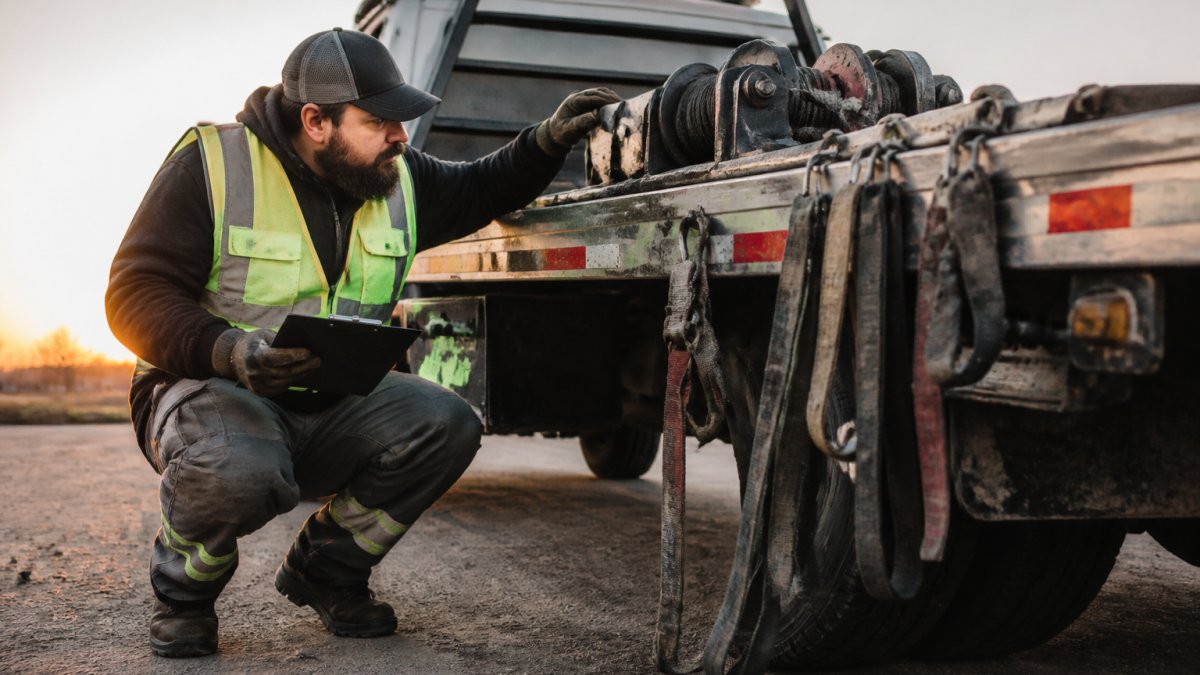
Pre-Trip, On-Scene, and Post-Tow Checks
Break inspection into three moments, each with its own short list.
- Pre-trip: lights, tires, winch, straps, chains, and fluid leaks
- On-scene: traffic control, rigging, load path, and vehicle security
- Post-tow: damage check, gear condition, and documentation
What to Look For, Not Just What to Check
A checklist item that says “inspect straps” invites a glance. A checklist item that says “look for cuts, glazing, embedded grit, and worn stitching” invites a real inspection. Write items around the failure mode.
- Webbing: cuts, burns, glazing, ultraviolet fading, embedded grit, and worn or pulled stitching
- Chain: cracked or deformed links, stretched links, worn hooks, and damaged latches
- Wire rope: broken wires, kinks, bird-caging, corrosion, and crushed or distorted strands
Securement Verification
Securement is where inspection and procedure meet. Before the vehicle moves, verify that the tie-downs are rated for the load, attached to the vehicle’s frame or approved points, and arranged to resist fore, aft, and lateral movement. Re-check after the first mile; straps settle, and a load that looked tight on the shoulder can shift on the first curve.
Testing Methods and Evidence
Field testing is not a single pull. A practical test protocol covers repeated use, real conditions, human factors, and failure mode.
- Repeated use: cycle the gear through many pulls and inspect after each cycle
- Real conditions: test in rain, heat, cold, and poor visibility, not just in the yard
- Human factors: confirm a tired driver can rig it correctly in the dark
Record what you tested, the conditions, and the result. A written test log turns a product claim into evidence your operation can rely on.
Maintenance Intervals and Retirement Criteria
Gear does not last forever, and the decision to retire it should be written down, not left to judgment at the scene. Set retirement criteria by gear type: webbing with cuts or glazing beyond a defined threshold, chain with cracked or stretched links, wire rope with broken wires or kinks, and hardware with bent hooks or missing latches. Remove retired gear from service immediately and document the removal.
Why This Discipline Pays Off
The FMCSA roadside inspection process rewards this discipline. Clean inspection records and operating records support carrier safety performance and protect your safety rating. The OSHA guidance on personal protective equipment makes the same point from a regulatory angle: equipment must be maintained and inspected, and a product that degrades quietly is a hazard, not a safeguard.
A checklist that lives in a binder is decoration. One that lives on the truck and gets signed is a safety tool. If drivers are skipping items, the list is too long, not too strict.
If you want a second set of eyes on your inspection program, a safety program review can confirm that your checklists, retirement criteria, and securement procedures hold up under real conditions.
Tow Truck Driver Safety Training That Sticks
Tow truck driver safety training sticks when it is hands-on and tied to the actual call, not a video and a quiz.
Training should be built around real scenarios: a night recovery on a curve, a vehicle with no wheels, a chain that fails mid-pull.
If you are weighing formats, our guide on how to choose between hands-on and online safety training breaks down the trade-offs for tow operations.
Towing Incident Reporting and Defensibility
Towing incident reporting and defensibility come down to records made in the moment, not after the claim. A photo, a signed checklist, and a clear narrative can separate a defensible incident from a costly one.
Build a simple reporting habit:
- Photograph the scene before and after the hookup
- Note weather, traffic, and vehicle condition
- Record which gear was used and its condition
For a deeper look at protecting your operation after an incident, read our strategies for towing company incident defensibility.
Request a Safety Program Review for Your Towing Operation
A safety program review finds the gaps before an incident does. If you are comparing providers, see our guide to safety consultants for towing to weigh your options and choose the right fit.
Scomac Associates LLC delivers hands-on, field-tested safety training and towing-specific policy development. We help you close the gap between written policies and real-world operations, improve incident reporting and defensibility, and support DOT compliance and fleet safety.
Frequently Asked Questions
What are the most important safety practices for tow truck drivers?
Set up the scene before touching the vehicle: warning lights, cones, and high-visibility gear go out first. Inspect straps, chains, and winch lines before every hookup, and confirm the load is secured before moving. Keep clear of the winch line and travel path while tension is applied. Follow the manufacturer’s rated capacity for every sling and strap, and document each tow. Towing safety depends on repeatable habits, not one-time effort, so build these steps into a written checklist drivers actually use.
How should tow operators secure a roadside scene before beginning recovery work?
Position the truck to shield the work area where possible, then place warning devices so approaching traffic has time to react. Turn on all warning lights, wear high-visibility clothing, and keep unnecessary people out of the travel lane. Work from the protected side of the vehicle. If the scene involves a hazardous spill, downed power lines, or a crash with injuries, call the appropriate responders before starting recovery. Scene setup is the first item on any towing safety checklist because struck-by incidents are among the most serious risks operators face.
How should tow truck drivers report incidents and near misses?
Fill out a written report the same day, while details are fresh. Record time, location, weather, vehicles involved, equipment used, witnesses, and photos of the scene. Near misses matter as much as damage incidents: a strap that slipped or a close call with traffic points to a procedure that needs fixing. Keep reports consistent across drivers so patterns emerge. A solid towing incident reporting process supports insurance claims, defends the company if a dispute arises, and feeds directly into training updates.
What should be included in a tow truck inspection checklist?
Cover the truck and the gear. On the truck: lights, brakes, tires, fluids, warning devices, and the winch and boom. On the gear: straps, chains, hooks, shackles, and slings, each checked for fraying, cracks, or deformation, with damaged items pulled from service. Note the date and initials on each inspection. A tow truck inspection checklist should separate pre-trip checks from on-scene checks and post-tow checks so nothing gets skipped under time pressure.
One bad incident can threaten a towing business overnight. The fix is not more paperwork, it is gear and training proven on a real call. Scomac Associates LLC builds hands-on instruction, towing-specific policy development, and incident reporting that holds up when it counts. Get started with Scomac Associates LLC and put field-tested safety to work on your next tow.
