Last Updated: November 15, 2026
Quick Summary
OSHA compliance applies to small towing operations even with only a few trucks and drivers, since federal OSHA standards cover most private employers regardless of size. Your obligations depend on the specific tasks your crews perform, such as roadside work, loading and securing vehicles, and training. Confirm whether your state runs its own State Plan, because that determines which rules you must follow.
- Small size does not exempt towing businesses from federal OSHA standards or the General Duty Clause.
- Vehicle operation on public roads falls under DOT rules, while roadside and yard work fall under OSHA.
- Check whether your state operates a State Plan, since its requirements may be stricter than federal OSHA.
- Write a separate loading procedure for each truck type, covering rigging, inspection points and restricted positions.
- Report fatalities within 8 hours and hospitalizations, amputations or eye losses within 24 hours.
Table of Contents
- Which OSHA Standards Apply to Small Towing Operations
- OSHA Regulations on Loading and Unloading Trucks
- Hazard Assessment for Roadside and Struck-By Exposure
- Tow Truck Driver Safety Training Requirements and Documentation
- Building a Towing Company Safety Manual Template
- OSHA Injury and Illness Reporting Requirements
- Common Compliance Pitfalls and Your Next Step With a Safety Program Review
- Frequently Asked Questions
Which OSHA Standards Apply to Small Towing Operations
If you run a towing company with a handful of trucks and drivers, OSHA compliance still applies to your workplace.
The practical question is which standards match what your crews actually do. Vehicle operation on public roads falls largely under Department of Transportation rules, while the work done on the roadside, at the storage yard and in the shop falls under OSHA.
Federal OSHA Versus State Plan Requirements
Federal OSHA enforces standards directly in states without an approved State Plan. Some states operate their own occupational safety programs that must be at least as effective as federal OSHA, and these State Plans may adopt additional or more specific requirements. Before building your program, confirm whether your state runs a State Plan, because the rules you must follow depend on it.
OSHA Regulations on Loading and Unloading Trucks
Loading and unloading a tow truck, wrecker or flatbed is not one task, and the OSHA standards that apply depend on where the work happens and what equipment is involved. Treating it as a single procedure is where most small operations get into trouble.
Which standards apply to which loading task
- Securing a vehicle on a flatbed or rollback. The general industry materials handling standard at 29 CFR 1910.176 covers secure storage of material and requires that storage areas be kept free from hazards such as slipping or falling objects. The construction counterpart, 29 CFR 1926.250, addresses stacking and securing materials and requires that loads be stable and employees kept clear of suspended or moving loads. Neither standard tells you how to chain a car down; they establish the duty to secure the load and keep workers out of the danger zone.
- Climbing on the bed or deck. Walking-working surfaces rules at 29 CFR 1910.22 require that surfaces be kept clean, dry and in good repair, and that fall hazards be addressed. Climbing onto a tilted flatbed or standing on a wheel lift to reach a strap is a fall exposure, and a written procedure should say whether ladders, steps or platform access are required rather than leaving it to the driver.
- Winching and dragging. Dragging a vehicle up a bed involves stored energy in the cable, chain or strap. The general industry standard at 29 CFR 1910.184 governs slings, and 29 CFR 1910.212 addresses machine guarding, which practitioners commonly apply to exposed winch drums, sheaves and power take-off drives. Inspect rigging before each use and remove damaged slings from service rather than tagging them for later.
Equipment and inspection specifics
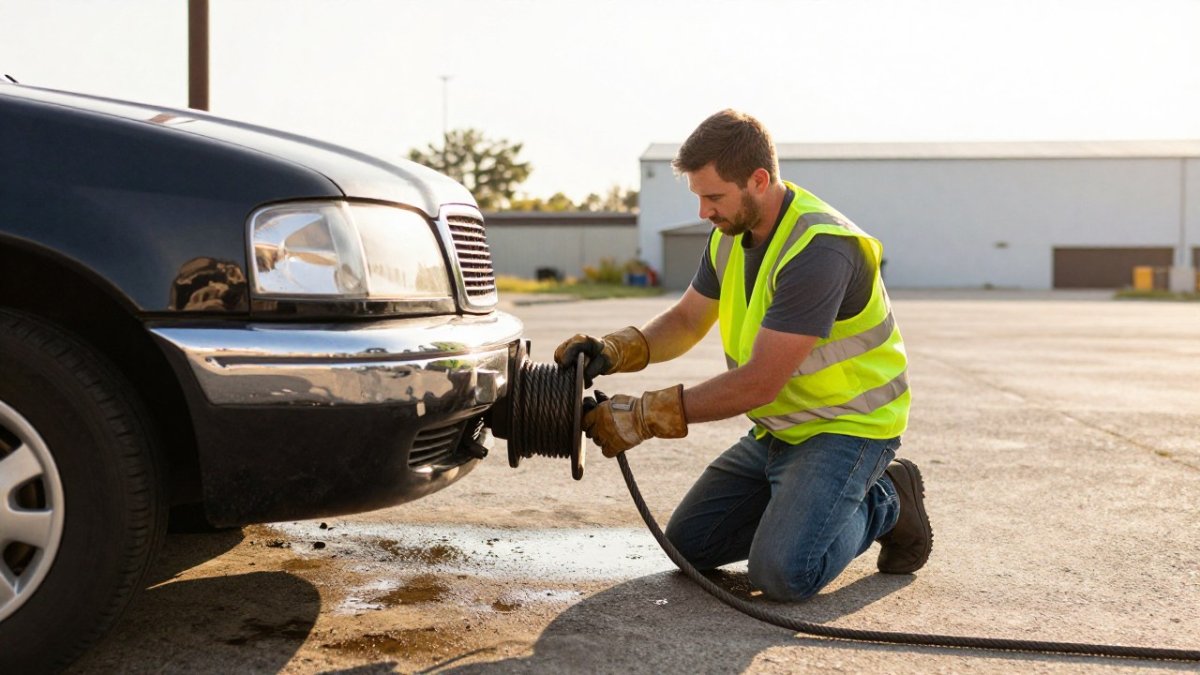
Chains, binders, straps, winch cables, hooks and snatch blocks all degrade. A practical inspection routine checks for cracked or stretched chain links, bent hooks, cut or abraded synthetic straps, kinked or birdcaged wire rope, and worn sheave grooves.
Watch out: a common failure is relying on the winch brake or a single tie-down to hold a vehicle while a worker reaches underneath. Use secondary securement and keep hands and bodies clear of the load path.
Writing a loading procedure that holds up
Write a separate procedure for each truck type in your fleet, because a wheel-lift wrecker, an integrated boom, a rollback and a heavy-duty rotator each present different load paths and different places a worker can be caught. Each procedure should state the sequence of steps, the rigging to be used, the inspection points, the positions workers must not occupy, and who is authorized to direct the lift.
Hazard Assessment for Roadside and Struck-By Exposure
Roadside recovery is one of the highest-exposure tasks in the towing business, and it is a central focus of any serious osha compliance effort.

A workable assessment follows four steps:
- Walk each typical job site and note traffic speed, lane position, sight lines and lighting.
- Identify every task that puts a worker between the truck and live traffic.
- Rank each hazard by how often it occurs and how severe an injury could be.
- Assign controls: positioning the truck as a barrier, using high-visibility apparel, setting warning devices and training crews to stay clear of moving lanes.
Document the assessment and review it whenever you add a new service area or type of equipment. A structured checklist for working through field risks can help you apply these steps consistently across crews.
The four-step assessment below summarises how to work through roadside and struck-by exposure.
| Step | What to do | Note |
|---|---|---|
| 1. Walk the site | Note traffic speed, lane position, sight lines and lighting | Do this at each typical job site |
| 2. Identify tasks | Find every task that puts a worker between the truck and live traffic | Focus on hookups and walking around a wreck |
| 3. Rank hazards | Rank by how often each occurs and how severe an injury could be | Frequency and severity |
| 4. Assign controls | Use the truck as a barrier, high-visibility apparel, warning devices and crew training | Keep crews clear of moving lanes |
Tow Truck Driver Safety Training Requirements and Documentation
Training for tow truck drivers should cover safe vehicle operation, load securement, equipment inspection, and how to work safely at a roadside scene. Consistent training and documented procedures help turn those requirements into safer daily practices, while Ideal Truck Service underscores the value of managing fleet safety as an ongoing responsibility.
OSHA requires employers to train workers in the hazards of their jobs and in the protective measures they must use. Keep records showing who was trained, the date, the topics covered and who conducted the session.
Scomac Associates LLC provides hands-on safety training for towing and recovery operators. To see how a structured program is built, review how small fleets build their driver training program on how small towing fleets build safety training.
Building a Towing Company Safety Manual Template
A written safety manual gives you one reference for policies, procedures and responsibilities. A useful template usually includes a company safety policy statement, roles for owners, managers and drivers, the hazard assessment process, a list of required training, incident reporting steps, and a schedule for reviewing the manual.
Start with a template and then tailor it to your operation. Add the specific procedures your crews follow for hookups, winching, roadside setups and yard work. You can review the approach in our guide to towing safety manual templates.
OSHA Injury and Illness Reporting Requirements
Small towing operators often assume that a handful of employees means no OSHA paperwork. That assumption is sometimes right and sometimes wrong, and the difference matters because the reporting obligations are separate from the routine recordkeeping obligations.
Recording versus reporting: two different duties
Recording means entering a work-related injury or illness on the OSHA 300 Log, the 300A Annual Summary, and the 301 Incident Report. Reporting means notifying OSHA directly about a severe incident. A business can be partially exempt from routine recording and still be required to report a fatality or a severe injury.
Which incidents must be reported to OSHA
Under the current recordkeeping rule at 29 CFR 1904, employers must report to OSHA:
- A work-related fatality within 8 hours of learning of it.
- A work-related in-patient hospitalization within 24 hours.
- A work-related amputation or the loss of an eye within 24 hours.
Reports are made by phone to the nearest OSHA area office or through the OSHA reporting line. Keep the confirmation and the details of what was reported. These timelines are short, and a towing operation that has never set up an internal notification chain will usually miss them.
The partial exemption and how to check your status
The recordkeeping rule partially exempts establishments with 10 or fewer employees at all times during the previous calendar year, and certain low-hazard industries listed in Appendix A to Subpart B of Part 1904. Towing and motor vehicle recovery work is not a low-hazard classification, so the size test is usually the deciding factor. Count employees carefully, including part-time and seasonal drivers, and confirm your status each year rather than assuming last year’s answer still applies.
Building an internal incident process
A workable process has four steps: the driver or operator reports the incident to a supervisor immediately, the supervisor secures the scene and arranges medical care, the employer determines within hours whether the incident triggers a reporting obligation, and the incident is recorded on the required forms if the establishment is not exempt. Assign a named person to make the OSHA call and a backup in case that person is unavailable.
Watch out: the 8-hour and 24-hour clocks start when the employer learns of the event, not when the paperwork is completed. A weekend incident with no one on call is a common way small fleets miss the deadline.
Records that support the process
Keep the OSHA 300 Log, the 300A summary posted each year from February 1 through April 30, and the 301 reports for each recorded case. Retain these records for five years following the end of the calendar year they cover.
If you are unsure whether your establishment is partially exempt or whether your incident response process would meet the reporting timelines, OSHA’s published recordkeeping guidance is the authoritative reference to check.
Common Compliance Pitfalls and Your Next Step With a Safety Program Review
The most frequent problems we see in small towing operations are outdated written programs, training that was never documented, roadside hazard assessments that were never done, and a manual that does not match how crews actually work.
A focused review can show you where your program stands and what to fix first. To see whether a review fits your business, request a towing safety consultation or explore how our field-tested safety solutions fit your operation.
Frequently Asked Questions
Do OSHA regulations apply to small businesses?
Yes. OSHA’s standards under the Occupational Safety and Health Act generally apply to employers regardless of size, so a small towing company with employees has the same core duty to protect workers. Size affects some obligations, though. Recordkeeping requirements for injuries and illnesses are limited for certain small employers, and some industries are exempt from routine recordkeeping. Owners should confirm their status against the current OSHA recordkeeping rules and check whether their state operates its own State Plan, since those programs can add requirements.
Does OSHA require a written safety manual for a small towing company?
OSHA does not require one document titled a safety manual in every case, but many of its standards require written programs, such as hazard communication and certain equipment or lockout procedures, depending on the work performed. A written manual is a practical way to organize those programs. A towing company should identify which standards apply to its activities, document how it trains employees on them, and keep records that show the procedures are actually followed.
When must a towing business report a workplace injury to OSHA?
OSHA requires employers to report a work-related fatality within 8 hours and an in-patient hospitalization, amputation, or loss of an eye within 24 hours. These reports are made to the nearest OSHA area office or through the federal OSHA reporting channels. Reporting obligations are separate from the injury and illness recordkeeping requirements, which apply on a different schedule and may not cover every small employer. Confirm current reporting requirements against OSHA’s published guidance before an incident occurs.
What safety training should towing company employees receive?
Training should match each employee’s actual tasks, including roadside hazard awareness, struck-by exposure from passing traffic, safe loading and unloading of vehicles, use of rigging and winching equipment, and use of personal protective equipment such as high-visibility apparel. Drivers also need instruction in safe operating practices and incident reporting. Document the date, content, and attendee list for each session, and retrain when procedures or equipment change.
What are common OSHA compliance mistakes in towing operations?
Common mistakes include assuming a small crew is exempt from written program requirements, failing to document training, relying on informal verbal instruction, and not updating procedures after equipment changes. Many companies also keep injury logs incompletely or report incidents late. Conducting a documented hazard assessment, keeping training records current, and reviewing incident logs each quarter address most of these gaps.
What OSHA requirements apply to loading and unloading tow trucks?
Loading and unloading work involves hazards addressed by general industry standards and, where applicable, by standards covering walking-working surfaces, materials handling, and powered equipment. Employers should identify the specific hazards of each vehicle and loading method, provide appropriate equipment and training, and keep work areas clear of traffic. The applicable standards depend on the operation, so a hazard assessment is the starting point for determining which requirements apply.
Which OSHA rules are most relevant to tow truck operators?
The most relevant rules usually involve hazard communication, personal protective equipment, walking-working surfaces, and the general duty clause that requires employers to protect workers from recognized hazards, including roadside traffic exposure. Operators should also understand how their own activities fall under transportation rules that the Department of Transportation administers, since some vehicle operation requirements are separate from OSHA standards.
