
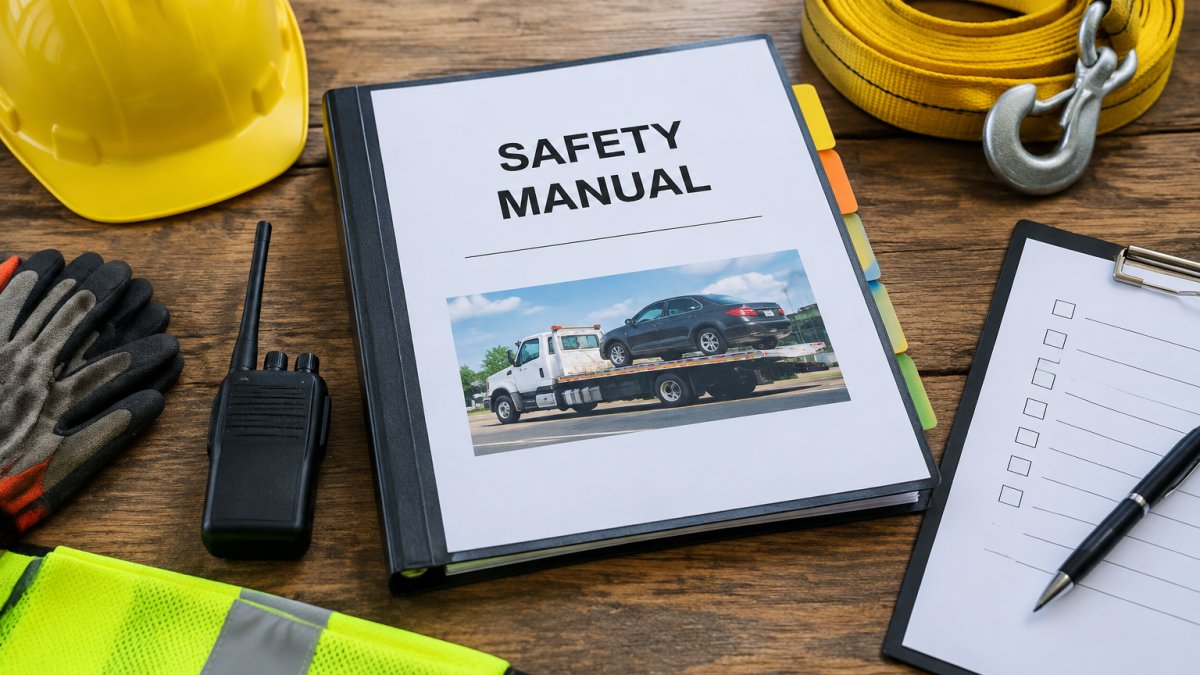
Last Updated: November 12, 2026
Quick Summary
A towing company safety manual should be built from a template only after checking that it covers towing-specific roadside work, not just general fleet policy. Good safety manual templates include scene protection, inspection records, incident reporting, and a revision schedule. Treat every template as raw material to adapt to your own procedures.
- Confirm the template covers hookups, winching, flatbed loading, and roadside scene protection.
- Prefer editable Word formats so you can insert your own procedures and dispatch rules.
- Match the template’s size to your fleet, since one-truck and 50-truck operations need different depth.
- Build a crosswalk tying each manual section to the regulation behind it, verified at the source.
- Test roadside sequences hands-on on real equipment before finalizing the manual.
Table of Contents
- What a Towing Company Safety Manual Needs to Cover
- Safety Manual Templates Worth Considering in 2026
- Fleet Safety Manual Template Sections for Tow Operations
- Roadside and Scene Protection Procedures for Tow Drivers
- Towing Company Incident Reporting Procedure and Post-Incident Review
- Tow Truck Driver Safety Training and Acknowledgment
- Tow Truck Inspection Checklist and Equipment Records
- Get a Safety Program Review for Your Towing Operation
- Frequently Asked Questions
A towing company safety manual is only as useful as the procedures it describes and the crews who follow them, so any safety manual templates you start from should be judged on how closely they match real roadside work.
This guide walks through what a towing manual should cover, which template sources are worth considering, and how to adapt a starting document to your operation.
What a Towing Company Safety Manual Needs to Cover
A towing manual must answer a practical question: what does a driver do, in order, when things go wrong? That means it needs to address the work itself, not only office policy.
Core topics typically include:
- Workplace health and safety policies and who is responsible for them
- Driver responsibilities, conduct, and hours-of-service awareness
- Vehicle inspection and preventive maintenance schedules
Where federal motor carrier rules apply to your operation, cite them from primary sources such as the FMCSA Motor Carrier Safety Planner. The planner is a useful reference for structuring carrier safety topics, though it is a guide rather than a finished company manual.
Safety Manual Templates Worth Considering in 2026
Templates are a reasonable starting point, but they vary widely in what they actually contain. Most free resources circulating for 2026 are general fleet, construction, or office-safety documents with a towing label attached. Treat every template as raw material to adapt, not a policy to adopt.
Where to source a starting document
Four source categories are worth evaluating, each with real trade-offs:
- Federal reference material. The FMCSA Motor Carrier Safety Planner is an official federal reference for structuring carrier safety topics. It is a guide, not a finished company manual, and it does not describe towing-specific recovery work. Use it to confirm which regulatory topics your manual must address, not as the manual itself.
- Insurance carrier and trade-association samples. Many insurers and state towing associations publish sample fleet manuals or handbook outlines. These tend to be editable and reasonably current, but coverage varies by carrier and state, and some are written for general trucking rather than light- and medium-duty towing.
- Free Word and PDF templates from general safety sites. These are the most common search result and the weakest fit. They are usually editable, but they were written for a different industry and require substantial rewriting of every operational section.
Selection criteria that actually matter
Compare candidates on these six points before you commit time to editing:
- Towing-specific coverage. Does it address hookups, wheel lifts, winching, flatbed loading, securement, and roadside scene protection, or only general driving and office policy?
- Editable format. Word or a comparable editable format lets you insert your own procedures, equipment lists, and dispatch rules. Locked PDFs force a full retype.
- Scale fit. A template written for a 5-to-50-truck fleet may be too thin for a single-truck operator or too heavy for a small crew. Match the document to your headcount and call volume.
- Update policy. A 2026 template that is never revised will drift out of date. Ask whether the source issues updates and how you will be notified.
- Regulatory grounding. Does it cite primary sources (FMCSA, OSHA) or make vague compliance claims? Prefer templates that point to the regulation rather than paraphrasing it.
- Acknowledgment and training hooks. Does it include sign-off pages, training records, and a revision log, or only policy prose?
The 2026 regulatory crosswalk
A template is only as good as the requirements it maps to. Before you adopt any document, build a simple crosswalk that ties each manual section to the requirement behind it. At minimum, confirm which of the following apply to your operation and verify the current rule text at the source, because requirements depend on vehicle weight, interstate versus intrastate operation, hazardous materials, and state law:
- FMCSA driver qualification and hours-of-service rules, apply to commercial motor vehicles above the applicable weight threshold and to interstate operations; intrastate and lighter-duty operations may fall under state rules instead.
- FMCSA vehicle inspection, repair, and maintenance requirements, periodic inspection and recordkeeping obligations that scale with fleet size and vehicle type.
- OSHA general industry and construction standards, workplace safety obligations that apply to your shop, yard, and employees, separate from the motor carrier rules that govern the vehicle on the road.
Watch out: a template that cites a regulation by number without confirming it still applies to your vehicle class and operating radius can create a false sense of compliance, verify each citation against the current rule before you adopt it.
No template replaces the crosswalk. The crosswalk is what turns a generic document into a defensible manual for your specific operation.
Fleet Safety Manual Template Sections for Tow Operations
A fleet safety manual template is most useful when its sections match how your business is organized. A workable structure for a tow operation looks like this:
- Purpose, scope, and management commitment
- Roles and responsibilities (owner, dispatcher, driver, shop staff)
- Driver qualification and conduct
- Vehicle inspection and equipment records
- Roadside and scene protection
- Incident reporting and post-incident review
- Training and acknowledgment records
- Review and revision schedule
For each section, replace generic language with your actual procedures. A dispatcher who knows which calls need a second truck is more valuable to a manual than a paragraph about general fleet oversight.
The eight sections below give a workable structure for a tow operation’s fleet safety manual.
| Section | Focus |
|---|---|
| 1. Purpose, scope, and management commitment | Sets the manual’s reach and leadership backing |
| 2. Roles and responsibilities | Owner, dispatcher, driver, shop staff |
| 3. Driver qualification and conduct | Who may drive and how they behave |
| 4. Vehicle inspection and equipment records | Inspections, repairs, and out-of-service decisions |
| 5. Roadside and scene protection | Procedures for working near traffic |
| 6. Incident reporting and post-incident review | Who reports what, and how reviews feed revisions |
| 7. Training and acknowledgment records | Documents training and employee sign-off |
| 8. Review and revision schedule | Keeps the manual current |
Roadside and Scene Protection Procedures for Tow Drivers
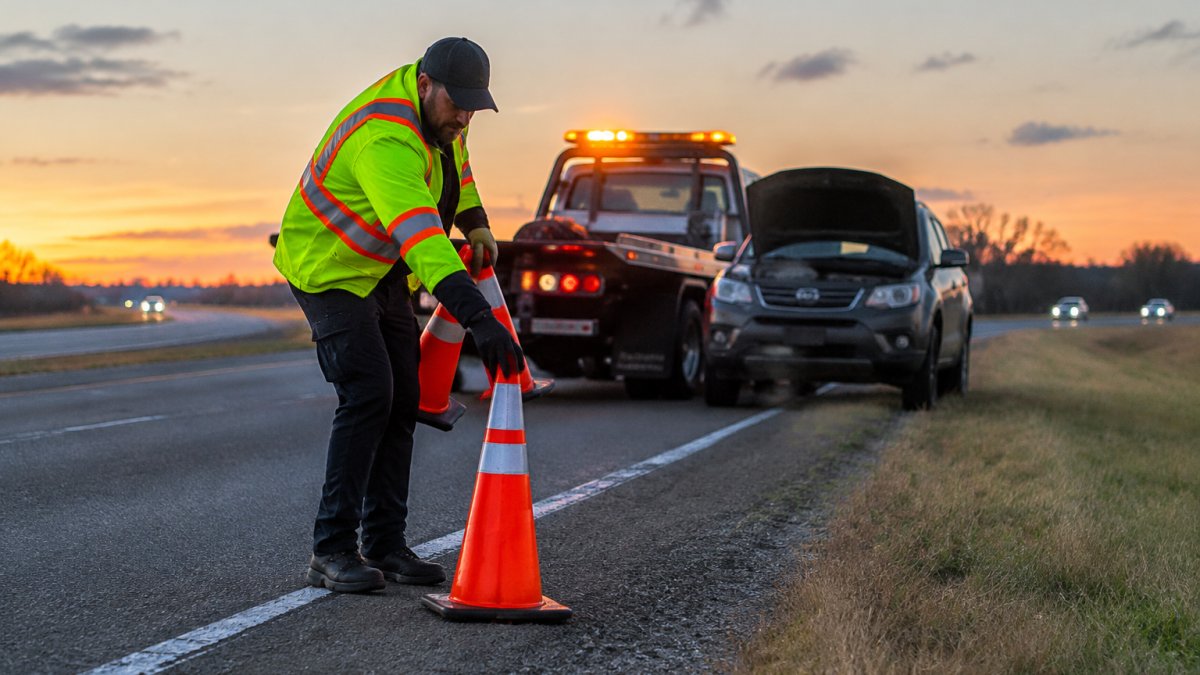
Roadside work is where many towing companies have the most exposure, and where generic templates say the least. Your scene protection section should read as a numbered sequence a driver can execute under pressure, not a paragraph about caution. A numbered sequence should also account for how scene decisions change when a roadside recovery becomes a long-distance tow, a distinction reflected in Miller’s Towing & Recovery.
Traffic positioning
Describe where the truck goes before the driver steps out. Cover:
- Blocking position. Where the tow vehicle is placed relative to the disabled vehicle and the traffic lane, and how that changes on a shoulder, a curve, a bridge, or a blind crest.
- Angle and offset. How the truck is angled to deflect traffic away from the work zone, and when a second vehicle is used as a buffer.
- Exit path. Which door the driver uses to leave the cab, the side away from traffic, and the rule for staying in the cab when traffic cannot be safely diverted.
High-visibility apparel
Specify what is worn, when, and by whom. At minimum, address the class of high-visibility garment required for roadside work, the requirement that it be worn whenever the driver is outside the vehicle near traffic, and how apparel is inspected and replaced when it becomes faded or torn. Confirm the current requirement against the applicable standard rather than relying on a template’s paraphrase.
Warning devices
Write the deployment sequence as steps: what devices are placed, in what order, at what distance behind and ahead of the scene, and how that distance changes with speed limit, curve, and visibility. Address:
- Cones versus flares versus reflective triangles, and when each is appropriate.
- Nighttime and low-visibility deployment, including lighting on the truck and on the scene.
- Retrieval, who collects the devices and when, so a driver is not walking into traffic to recover a cone after the hookup.
Safe approach zones
Define the zone around the scene where the driver works and the zone traffic is kept out of. Cover the approach path from truck to disabled vehicle, the rule for approaching from the traffic-safe side, and the hand signals or radio protocol between driver and spotter when a second crew member is present.
Common mistakes we see
- Relying on a verbal understanding instead of a written sequence for every hookup.
- No defined rule for nighttime or low-visibility calls.
- Drivers improvising scene setup because the manual is silent on their situation.
Watch out: a scene protection section that lists devices but never states distances, order, or the cab-stay rule gives a driver nothing to follow when traffic is moving, write the sequence as numbered steps and have experienced drivers walk through it on actual equipment.
Procedures that only exist on paper rarely hold up under pressure. Test the sequence in a controlled setting, then revise the manual to match what the crew actually does.
Towing Company Incident Reporting Procedure and Post-Incident Review
An incident reporting procedure should state who reports what, to whom, and by when.
Post-incident review is equally important. A review should ask what happened, why the written procedure did or did not prevent it, and what changes the manual needs.
Setting a fixed window for reviews, such as within a set number of days, helps ensure reviews happen while details are still fresh.
Tow Truck Driver Safety Training and Acknowledgment
A manual that drivers never read protects no one. Pair the manual with training that walks through the actual procedures and document each employee’s acknowledgment. Initial training and refresher training should be tracked separately, and refresher training should occur when procedures change or when an incident reveals a gap.
Training works best when it is hands-on. Classroom review of hookup sequences is useful, but practicing those sequences on a yard or in a controlled setting shows whether a driver can execute them.
Tow Truck Inspection Checklist and Equipment Records
Inspection records are among the first things reviewed after an incident. Your manual should specify what is checked before each shift and what is checked on a periodic schedule: brakes, lights, tires, winch lines, chains, straps, wheel lifts, and safety equipment such as cones and flares.
Keep records of inspections, repairs, and out-of-service decisions. A checklist that a driver fills out and a supervisor reviews creates a traceable record. Define who can take a truck out of service and how the decision is documented.
Get a Safety Program Review for Your Towing Operation
If you already have a manual but are unsure whether it reflects your real operation, a safety program review is a practical next step.
Scomac Associates LLC offers towing-specific policy development and hands-on safety training for towing, emergency response, and industrial operations. If your procedures have not been tested on the road, request a consultation to see where they need work.
Frequently Asked Questions
What should a towing company safety manual include?
A towing company safety manual should cover driver responsibilities, vehicle inspection and maintenance, roadside and scene protection, hook-up and recovery procedures, dispatch and operating procedures, incident reporting, and training and acknowledgment records. Each section should describe what employees must do, who is responsible, and how the company documents compliance. Where a rule comes from a federal or state requirement, cite it. Where it reflects company policy or industry practice, label it that way so employees and auditors can tell the difference.
Does OSHA require towing companies to have a written safety manual?
OSHA does not require a single document titled safety manual for every towing company, but several OSHA standards require written programs or documented procedures depending on the hazards present in your operation. Federal motor carrier rules administered by FMCSA also carry their own requirements for commercial motor vehicles. Because applicability depends on your operations, employee exposures, and vehicle type, review the specific standards that apply to your work or request a compliance assessment before assuming your current documents are sufficient.
Can I use a general fleet safety manual for a towing company?
A general fleet safety manual can serve as a starting point, but it usually misses tow-specific work such as scene protection on live roadways, winch and recovery operations, and dispatch procedures for hook-ups. Review every section and replace generic content with procedures your drivers actually follow. A free template can save drafting time, but the manual only protects you if it reflects real operations and employees are trained on it.
How often should a towing company review its safety manual?
Review the manual at least annually and whenever regulations change, equipment is added, an incident reveals a gap, or operations shift to new service types. Track version numbers, record the date of each revision, and collect signed employee acknowledgments for each new version. Consistent review and documentation are what make the manual defensible if an incident leads to a claim or inspection.
